PurePower: An Advance in Aircraft Propulsion
Robert Springer | February 23, 2016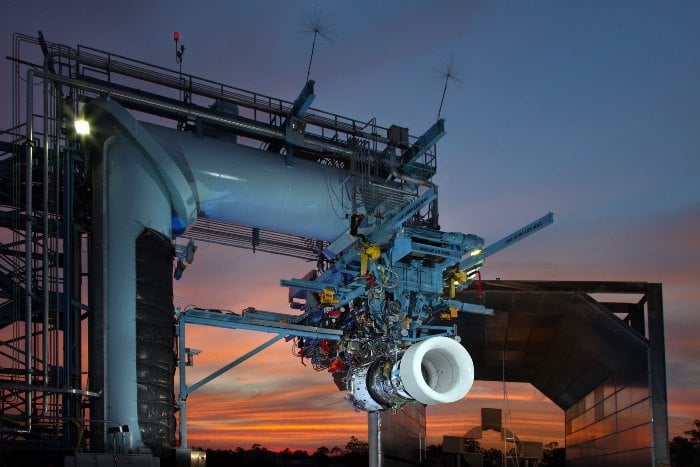 The PW1217G engine in ground-test configuration. Image source: Pratt & Whitney.
Lighter and more aerodynamically designed planes have saved airlines millions of dollars in aviation fuel and reduced carbon dioxide emissions, but advances in jet engine design weren’t keeping pace. That has changed, however, as five airlines have started taking delivery of a new type of turbofan jet engine that experts say is a leap forward in engine design.
Commercial service began in January for Pratt & Whitney’s PurePower geared turbofan (GTF) jet engine, which took more than 30 years and $10 billion to develop. The science behind the effort to develop a quieter, more efficient jet engine is a story of creative engineering and perseverance.
Not Your Father’s Jet Engine
While superficially similar to other turbofan jet engines, PurePower engines offer several advantages, according to Michael McCune, design manager of fan drive gear systems at Pratt & Whitney. For example, the engines have a greater than 16 percent fuel burn reduction, which reduces carbon dioxide emissions. They’re also quieter than existing engines, creating up to 75 percent less noise on the ground. That may enable carriers to pay lower noise fees and travel over some residential areas that are no-fly zones for regular planes, says McCune.
 Michael McCune, Pratt & Whitney. The engine has fewer parts – 2,000 fewer airfoils and six fewer stages – so maintenance needs also may be reduced. “The overall combined GTF engine benefits equal operator savings greater than $1.5 million per aircraft, per year,” McCune says.
An aeronautic engine design expert not affiliated with Pratt & Whitney says that the PurePower engine represents an important advance. “I think it’s huge; it’s a big step,” says Zoltan Spakovszky, director of the Gas Turbine Lab at the Massachusetts Institute of Technology’s Department of Aeronautics and Astronautics. “One could argue it’s an evolution from turbojet to turbofan, to a gear turbofan.”
Direct Drive vs. Geared Turbofan Engines
In conventional jet engines, the fan and power turbine are directly linked and consequently run at the same speed. For optimum efficiency, however, the components need to run at different speeds, says Spakovszky. “The issue is the fan wants to go slow, but the low-pressure compressor, low-pressure turbine, wants to go fast for efficiency so there has to be compromise in the design,” he says.
Direct drive systems get around the problem by defaulting to a common speed, an inefficient compromise, McCune says. “If you optimize the fan size and speed, the slower turbine requires additional stages to extract the same work.” These additional stages increase the size and weight of the engine, defeating the benefit of the larger, slower fan.
Pratt’s approach, McCune says, was to introduce a reduction gear system that allows the fan and turbine to run at optimum speeds – “thus, the geared turbofan engine.”
Geared turbofan engines have been around since the 1970s, Spakovszky says. Their use, however, was largely limited to business jets and small commercial planes as aeronautical engineers hadn’t devised a way to scale up the engine to power larger aircraft. Pratt’s GTF engine scales to mid-sized planes like the Airbus 320.
McCune says that the 1970s-era GTF engines were “limited to about 5,000 shaft horsepower (SHP) and were designed at a bypass ratio [of] about 5 to 1. They did not take advantage of the full benefits available from this architecture.” The problem, he says, lay in scaling the gear system to the single-aisle aircraft size that requires around 30,000 SHP, six times larger than what had been produced in the past, with a relatively small increase in size.
Epicyclic Gear System
 Airflow path in the PurePower engine. Image source: Pratt & Whitney.P&W engineers used an epicyclic gear system to solve the problems. The gears are compact and “have coaxial input and output shafts and are capable of a broad reduction range,” McCune says. The PurePower engine uses a star-type system, “where the input from the turbine drives the central gear, called a sun gear.” Surrounding the sun gear are fixed star gears. The star gears are surrounded by a ring gear on the outside of the system that, in turn, drives the fan shaft. The bearings supporting the star gears are capable of driving the system in high load applications.
The power density problem was solved by using a new type of oil film journal bearing. The bearing’s increased load capacity allowed it to fit inside the gear system “and lets the system be sized by gear requirements and not bearing capability,” says McCune. Efficiency was improved by understanding how heat was generated in the gear system and learning how to minimize heat as horsepower was increased. The engineers found that the location and control of oil in the system was critical to minimize heat. “Pratt & Whitney’s GTF engine gear systems today are running at well over 99 percent efficiency,” McCune says.
One final problem to solve was durability. McCune says that gears generally have long lives if they are kept lubricated and in proper alignment, especially in high horsepower applications like jet engines. P&W engineers didn’t want to hard mount the gears to the engine case because the lightweight structures could bend during flight, possibly resulting in gear misalignment leading to premature failure. Instead, they designed a “gear system that follows the fan shaft as it bends and floats free of the engine cases,” McCune says. “The isolation from the cases is achieved with a system of flexible connection and controlled spring rates to ensure stable rotor dynamic operation. The system is so well isolated that is has been proved to be reusable after a fan blade out event.”
The skill that McCune and his team demonstrated in scaling up the GTF engine made an impression on Spakovszky. “Pratt has demonstrated a very reliable gear,” he says. “It took 30 years, but these challenges aren’t trivial.”
Despite helping to drive change in aviation technology, McCune isn’t ready to fly off into the sunset. “I’ve always been a person that likes a challenging problem, so I’m already working on what the engine architecture and gear reduction system will look like in 2030,” he says.
Until true supersonic flight becomes possible, incremental advances like the PurePower engine will keep air travelers moving, more quietly and efficiently than before.