This mind-reading AI can turn thoughts into text
Marie Donlon | December 12, 2023A team of researchers from the GrapheneX-UTS Human-centric Artificial Intelligence Centre at the University of Technology Sydney (UTS) have reportedly created a portable, non-invasive system capable of decoding a person’s thoughts and turning them into text.
To develop the device, participants were tasked with silently reading passages of text while wearing an electroencephalogram (EEG)-equipped cap, which recorded electrical brain activity through the wearer’s scalp.
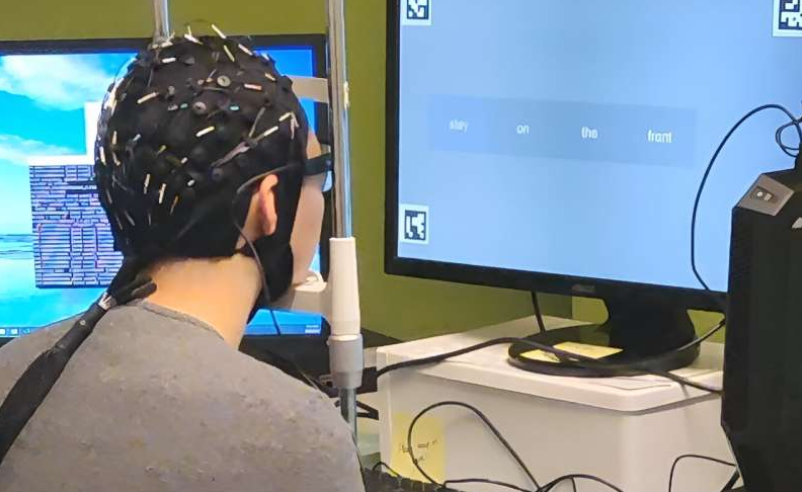 Source: UTS
The researchers explained that the EEG wave is apportioned into specific modules that capture distinct characteristics and patterns from the human brain via an artificial intelligence (AI) model created by the team of researchers and dubbed DeWave. According to the UTS team, DeWave translates the captured EEG signals into actual words and sentences based on what it has learned from the large quantities of EEG-associated data.
During trials of the system, the researchers explained: "The model is more adept at matching verbs than nouns. However, when it comes to nouns, we saw a tendency towards synonymous pairs rather than precise translations, such as 'the man' instead of 'the author.'"
"We think this is because when the brain processes these words, semantically similar words might produce similar brain wave patterns. Despite the challenges, our model yields meaningful results, aligning keywords and forming similar sentence structures," the team added.
The UTS team reported that when tested, the system achieved a translation accuracy score of roughly 40% on BLEU-1 — which is a number between zero and one that compares the likeness of machine-translated text to reference translations. In the future, the UTS team aims to improve that score.
Possible applications for the system include assisting people who are unable to speak due to illness or injury, such as stroke or paralysis, or to enable communication between humans and robots.
An article detailing the technology, “DeWave: Discrete EEG Waves Encoding for Brain Dynamics to Text Translation,” will be presented at the NeurIPS conference, which is an annual meeting that demonstrates research on AI and machine learning, held in New Orleans on December 12, 2023.
For more information on the technology, watch the accompanying video that appears courtesy of UTS.