
Video: Shining a light on radioactive materials
S. Himmelstein | January 24, 2024A radiation detection technology developed by researchers from Blueshift Optics and U.S. Sandia National Laboratories (SNL) provides a new tool to enhance national security and strengthen nuclear safeguards.
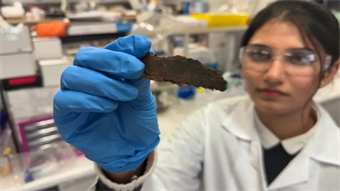
The new organic glass scintillators emit light in the presence of radiation and can more efficiently decipher between neutron and gamma ray radiation relative to existing technologies. The scintillators allow for faster identification of potential threats and are simpler and less expensive to produce.
 Source: Blueshift Optics
The instruments are based on a stable, amorphous, small-molecule host matrix that contains performance-enhancing additives such as wavelength shifters. Properties include scalable production via melt-casting, scintillation light yields and pulse-shape discrimination properties that are comparable to crystalline trans-stilbene, and isotropic optical and mechanical properties that are reminiscent of plastic scintillators. The unique properties of organic glass allow for casting into molds and complex shapes such as bars, cylinders, cubes and pixelated arrays.
The scintillator transforms energy into visible light for easier detection and is coupled with high sensitivity photo multiplier tubes or detectors that read out the signals. In addition to finding radiological material and preventing its transport via border crossings and ports, the scintillators can find application in nuclear physics experiments.
“Our materials produce a lot more light, double compared to what used to be state-of-the-art,” explained SNL materials scientist Patrick Feng. “There are fewer false positives, and you can detect rarer events with our material. You can detect them faster or from a greater distance. These are things that matter. At a border crossing, it can take 30 minutes to scan one truck. That doesn’t work. We are striving to enhance national and international security and safety; that is the mission. We need practical technology, and we make the practical possible.”

This needs to be checked to see whether it would be an aid to fire, EMS, and other emergency departments that need to know quickly whether radiation is present or not.