Geospatial dataset maps large-scale photovoltaic projects in the US
S. Himmelstein | December 13, 2023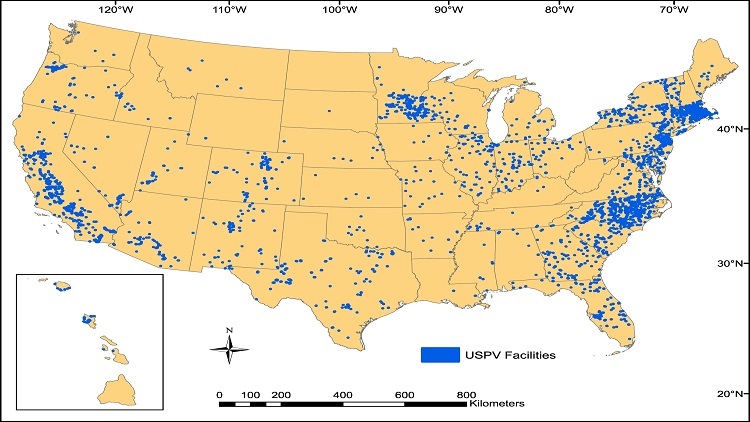 Locations of facilities included in the USPVDB. Source: USGS and LBNL
A collaboration involving U.S. Lawrence Berkeley National Laboratory (LBNL) and the U.S. Geological Survey (USGS) has produced a detailed and comprehensive dataset of ground-mounted large-scale solar (LSS) photovoltaic energy facility locations and their attributes in the U.S.
The U.S. Large-Scale Solar Photovoltaic Database (USPVDB) enables analysis of the historical trends in LSS and the accurate assessment of potential costs and benefits of future development. The dataset comprises 3,699 LSS ground-mounted facilities with capacities greater than 1 MW DC in operation across 47 states and Washington, D.C., through the end of 2021.
The USPVDB augments information collected by the U.S. Department of Energy since 2020 by providing data on the total footprint area and detailed attributes of each facility, including panel technology type, axis type, year of installation and generation capacity. Researchers and other stakeholders can use the data to analyze the role of solar energy in decarbonizing the U.S. electric grid, improve studies on the interactions between photovoltaic facilities and the natural environment, and plan investments in photovoltaic infrastructure.
An article published in Nature Scientific Data describes the USPVDB and its development process. The dataset, which will be updated annually, will be downloadable in multiple formats and accessible via an online map viewer.