Pickleball tech: The science behind the serve
Phil Hipol | October 20, 2023Pickleball has become the fastest growing participation sport in the U.S. among all age groups. It is played with what looks like an oversized ping-pong paddle and a ball that resembles a plastic wiffle ball on a court that is roughly one-third the size of a tennis court.
Pickleball is a game of geometry and trajectory, the latter of which is dictated by Newton’s Third Law. In a competitive and lucrative sport like pickleball, the force impact from the player’s swing to the ball determines the quality of the shot. These paddles started as simple wooden ping-pong paddles but have transitioned into application-designed and precision-manufactured gear made from the highest quality materials – all in the name of a competitive edge.
There is an equally fast-growing market for the companies and engineers who create the most quintessential of pickleball equipment, the paddle.
Paddle history
When pickleball was invented in 1965, the players used wooden ping-pong paddles and a large wiffle ball on a standard sized badminton court with the net five ft off the ground. When the players found that the ball bounced well on a hard surface, they lowered the net to the height of a tennis net, and thus the beginnings of the modern sport of pickleball were established.
These paddles were eventually replaced by larger wooden paddles made from plywood, which became the standard until about the mid-1980s. At this point, composite materials – used extensively in the aerospace industry – started to become more commonplace, especially in sporting goods. In fact, golf and tennis had started to boom in the late-1970s and early-1980s, which fueled the interest in the lighter weight and more durable composite materials. While you can still buy and use wooden pickleball paddles, the trend toward lightweight composite pickleball paddles has continued to the present day.
The need for lightweight but strong paddles
High strength and lightweight composite pickleball paddles have several advantages over wooden paddles. Firstly, they allow the player to increase his or her swing speed, thereby increasing the momentum and velocity that can be transferred to the ball. They also allow players to maneuver their paddles easier, which becomes critical for fast volleys near the net where the ball may be returned to the player’s forehand or backhand side. Noteworthy, too, is that they reduce muscle fatigue and stress so that players may be less susceptible to arm injuries such as tennis elbow or rotator cuff tears. In spite of their light weight, the paddles must also be sufficiently stiff to minimize deflection and remain undamaged when slamming the ball.
With the numerous benefits of lightweight but stiff paddles, it is no wonder that all high-performance pickleball paddles are increasingly being made of high-tech composite materials.
Modern pickleball paddle construction
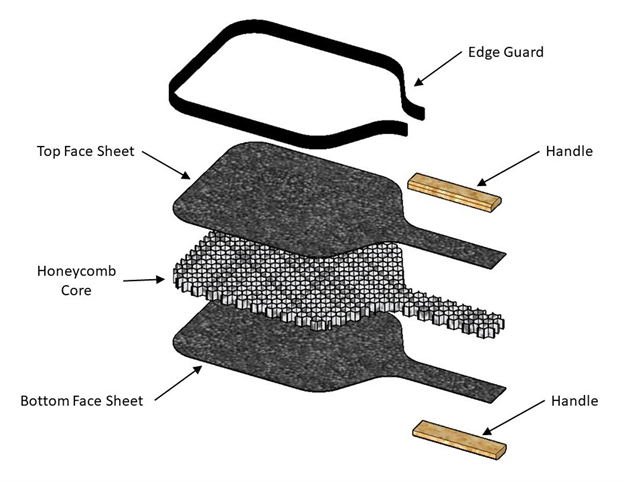 Figure 1. Components of a pickleball paddle. Source: pickleballscience.org
Most modern pickleball paddles start from a typical sandwich panel consisting of face sheets that are adhesively bonded to a core material (Figure 1). The panel is then cut into the desired paddle shape using a CNC mill or a waterjet cutter. Logos, labels, paints and coatings are then applied to the paddle blank. A plastic edge guard and handle are bonded to the paddle, followed by the handle wrap. The completed paddle is then packaged for sale and shipping.
Besides the shape and weight distribution of the paddles, the materials and construction of the core materials and the composite honeycomb panels are the key differentiators among the different paddles on the market.
Cores
Starting from the inside of the paddle, the core material is typically an extremely lightweight polypropylene honeycomb. Other core materials may include aluminum honeycomb, aramid (Nomex) honeycombs or foams (also known as EVA); however, these materials are less popular than polypropylene. Foam cores, in particular, are not approved by pickleball governing bodies because they are too soft and are considered to provide players with an unfair advantage compared to paddles with polypropylene honeycomb cores. The core provides shear stiffness to the paddle and separates the face sheets. In general, paddles with thicker cores have a higher bending stiffness than paddles with thinner cores. Currently, the thinnest cores are about 11 mm thick, and the thickest ones are about 19 mm thick.
Face sheets
The face sheets provide a surface to contact the ball and give the paddle its bending stiffness. They consist of several unidirectional fiber plies of fiberglass, carbon fiber, Kevlar or graphite arranged in a balanced lay-up. Carbon fiber and graphite face sheets are among the stiffest of materials and have about the same stiffness as aluminum at a fraction of its weight. Fiberglass and Kevlar have a lower stiffness and higher mass. Pickleball paddle manufacturers will typically apply a coating or surface texture to the paddle faces to increase the friction between the paddle and the ball to enable players to apply spin to the ball. The coatings may be enhanced by the use of a fine grit, or the surface of the face sheets may be roughened by the use of a textured peel ply during molding.
What’s next in paddle technology?
Pickleball paddle manufacturers can adjust the performance characteristics of their paddles by mixing and matching the various face sheet and core materials. There are literally hundreds of different combinations of face sheet and core materials available using different thicknesses, geometries, and manufacturing techniques.
As the popularity of pickleball continues to grow, pickleball paddle manufacturers will continue to develop “the next best thing” for players seeking to gain a competitive advantage. For engineers, it is a way to keep an eye on sports materials science – and maybe pick up a hobby no longer culturally reserved for the golden years.
Enjoying GlobalSpec's lifestyle engineering content? Browse our extensive newsletter catalog for more.