Touchless Device Provides Early Warning of Heart Problems
Engineering360 News Desk | February 10, 2016A portable system that monitors a patient's blood flow at multiple arterial points could lead to improved detection and prevention of some cardiovascular issues, as well as greater independence for older adults. Researchers at the University of Waterloo in Canada used coded hemodynamic imaging technology to develop a device that monitors a patient's blood flow at multiple points simultaneously and without direct contact with the skin. It is suitable for assessing patients with painful burns or highly contagious diseases, or infants in neonatal intensive care whose tiny fingers make traditional monitoring difficult.
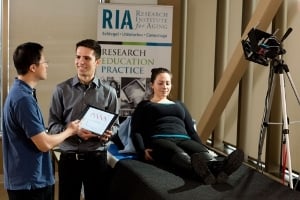 Researchers analyze blood-flow data extracted via the touchless device, pictured right. Image credit: Fred Hunsberger/University of Waterloo."Traditional systems in wide use now take one blood pulse reading at one spot on the body," says Robert Amelard, a Ph.D candidate in systems design engineering. "[Our] device relays measurements from all of these pulse points to a computer for continuous monitoring."
The technology is a non-contact transmittance photoplethysmographic imaging system comprising a 100 fps camera, a high-powered LED (655 nm), a microcontroller to synchronize frame captures and illumination and image- and signal-processing software on a computer. It monitors cardiovascular activity remotely by correcting for ambient lighting fluctuations and extracting the subtle blood pulse signal using signal-processing tools.
According to the researchers, continuous data collection at different parts of the body provides a more complete picture of what’s happening and opens doors for advanced monitoring that can’t be done with traditional, single-point methods.
“Since the device can also scan multiple patients individually at once and from a distance, consider the potential in mass emergency scenarios or long-term care homes,” says Alexander Wong, assistant professor of engineering. “This technology provides for a more predictive approach to monitor vitals, and the potential for its use is extensive, such as indicating arterial blockages that might otherwise go undetected or warning older adults who risk falling as a result of getting dizzy when they stand.”