Engineered Bacteria Creates Bio-pathway to Green Plastics
Engineering360 News Desk | February 10, 2016Agricultural crops, notably corn and sugarcane, are now used to produce a host of non-food products ranging from bioplastics to automobile fuel in response to environmental concerns. However, there’s growing worry that turning more agricultural land into non-food production will decrease the world’s food supply and drive up prices.
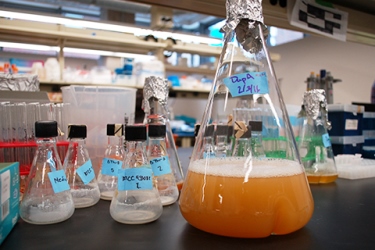 Researchers use engineered bacteria created in the lab to produce green chemicals. Credit: University of Minnesota Producing fuels and non-petroleum-based plastics from chemicals derived from plant waste could solve the dilemma. Researchers at the University of Minnesota appear to have done just that. The researchers have built an artificial biosynthetic pathway to produce 1,4-butanediol, or BDO, from lignocellulosic biomass, or basic agricultural waste. The high-quality intermediate BDO and its derivatives are widely used for producing elastic fibers, plastics, solvents and electronic chemicals.
To establish the new platform pathway, researchers examined the gene sequences from bacteria and fungi that turn the biomass into tricarboxylic acid, or TCA, intermediates. The metabolic platform, called nonphosphorylative metabolism, enables the production of green chemicals from the TCA cycle in fewer steps than conventional pathways and with significantly higher yields.
This new pathway to BDO, for example, could enable biomanufacturing of the estimated 1 billion pounds of spandex produced each year for clothing and home furnishing applications. But more than that, says lead researcher Kechun Zhang, a chemical engineering and materials science assistant professor at the University of Minnesota College of Science and Engineering, the platform could be used to convert agricultural waste to chemicals that can be used for a host of other products ranging from chicken feed to flavor enhancers in foods.