
The case for heat pump usage in Europe
S. Himmelstein | October 25, 2023Heat pump technology offers an energy-efficient and less polluting alternative to space heating under European climatic conditions relative to fossil fuel-based and electric resistive heating systems.
Air-source heat pump efficiency data available for a range of European and North American climatic zones were analyzed relative to the average coefficient of performance (COP) and average outside temperature. Standard air-source heat pumps can maintain average COPs between 2 and 3 in mild cold climates and (2) cold-climate air-source heat pumps can see COPs above 1.5 in extreme low temperatures, even at -30° C.
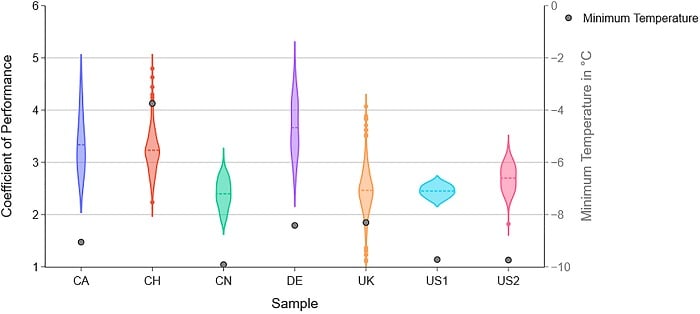 Range of coefficient of performance when outside temperature is between −10° C and 5° C. Source: Joule (2023). DOI: 10.1016/j.joule.2023.08.005
The analysis conducted by researchers from the University of Oxford (U.K.), Regulatory Assistance Project (Belgium) and Ulster University (U.K.) reveals that when the outside temperature was between 5° C and −10° C, the mean COP across all systems was 2.74 and the median was 2.62. These COPs are sufficient to meet heating loads at much higher efficiency than fossil heating and electric resistance heat alternatives.
Air-source heat pumps can operate at more than twice the efficiency of combustion or resistive electric heating technology and contribute to decarbonization efforts.
This research is published in Joule.


If the heat pump runs on electricity and your furnace heats with gas, you have to factor in the ratio of price of energy of gas versus electricity.
"The economics of heat pumps are driven by the ‘gain’, the amount of heat output per unit electricity input, and by the ratio between electricity and gas prices. New data from the Energy Systems Catapult reveals that the typical heat pump delivers a gain of 2.8, but the price ratio is 4. This means that the majority of people will find a heat pump more expensive to run than a new gas boiler."
https://www.thegwpf.
If your electricity is hydroelectric, heat pumps are a good deal. If it is generated by burning fuel, the Carnot efficiency of converting heat into mechanical energy to drive a generator may well result in more fuel being burned at the power plant than would be burned heating your home.