This artificial olfactory system detects food spoilage in real-time
Marie Donlon | September 20, 2023Researchers from South Korea’s Seoul National University have developed an energy-efficient computing-based chip featuring smell-sensing units that reportedly detect food spoilage in real-time.
The new artificial olfactory system (AOS) reportedly requires little energy to operate unlike similar AOSs that consume considerable energy. Further, the new AOS also incorporates both sensing and computing units on one chip.
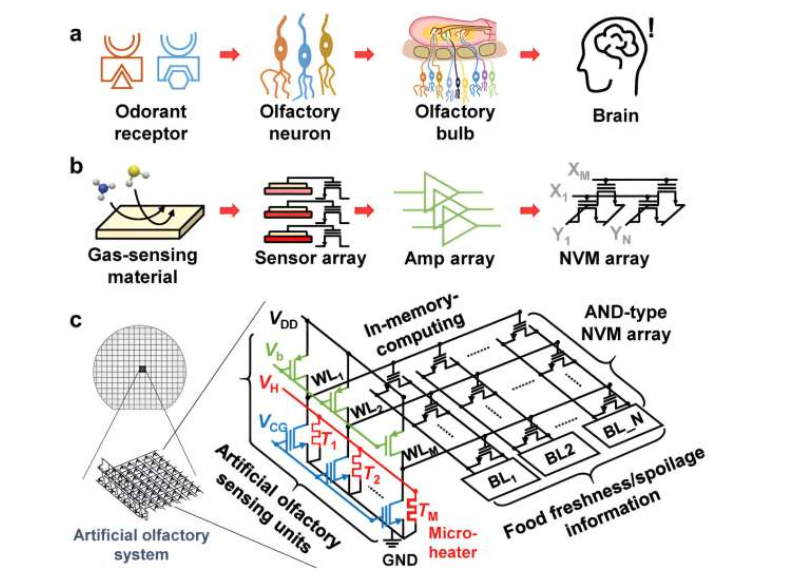 Biological olfactory system and proposed artificial olfactory system. a) Sequence of odor detection by the biological olfactory system. b) Sequence of gas detection by the proposed artificial olfactory system. c) Schematic diagram of the proposed artificial olfactory system. Source: Advanced Science (2023). DOI: 10.1002/advs.202302506
To detect food spoilage, the Seoul National University chip uses thin zinc oxide films capable of sensing even extremely low levels of hydrogen sulfide and ammonia gases — otherwise known as high-protein food spoilage indicators.
In the lab, the researchers tested the AOS on the spoiling process of chicken tenderloin, continuously tracking freshness scores and food conditions over a period of time. The researchers explained that the AOS platform could eventually be used for various other applications by making adjustments to gas-sensing materials and other parameters.
"Our artificial olfactory system is extremely energy- and area-efficient since the sensing and processing units are integrated and operate concurrently like a biological olfactory system," the team explained.
The AOS is detailed in the article, Energy Efficient Artificial Olfactory System with Integrated Sensing and Computing Capabilities for Food Spoilage Detection, which appears in the journal Advanced Science.