A shakeup in earthquake forecasting
S. Himmelstein | October 24, 2023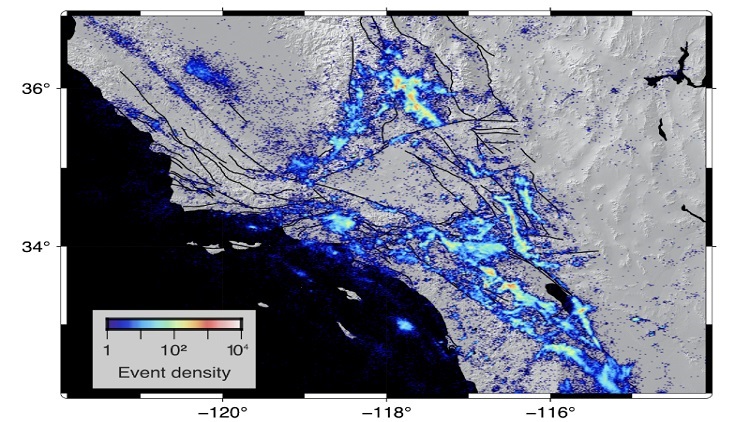 Some of the individual pixels represent thousands of earthquakes in this map from the Southern California Earthquake Data Center. Source: University of California Santa Cruz
The capacity to accurately predict earthquake aftershocks has been expanded with a new approach that can better dissect the enlarged seismology datasets accumulated over the last few decades. The new deep learning model developed by researchers from University of California Santa Cruz and Technical University of Munich (Germany) is more flexible and scalable earthquake forecasting models currently in use.
As the existing Epidemic Type Aftershock Sequence (ETAS) model cannot accommodate large data sets, the researchers turned to deep learning technology to design the Recurrent Earthquake foreCAST (RECAST) method. This new system builds on recent developments in machine learning known as neural temporal point processes and uses a general-purpose encoder-decoder neural network architecture that predicts the timing of the next event given the history of past events.
The study published in Geophysical Research Letters confirms that RECAST outperformed the older ETAS model for earthquake catalogs of about 10,000 events and greater. When tested with real data from the Southern California earthquake catalog, the new model proved superior to ETAS, particularly as the amount of data increased. The computational effort and time were also significantly better for larger catalogs.
The ability to adapt to large amounts of new data is expected to allow deep learning models to large incorporate information from multiple regions at once to make better forecasts about poorly studied areas. These methods should also allow researchers to expand the type of data used to forecast seismicity.