Per-unit system for power system analysis
N. Mughees | September 22, 2023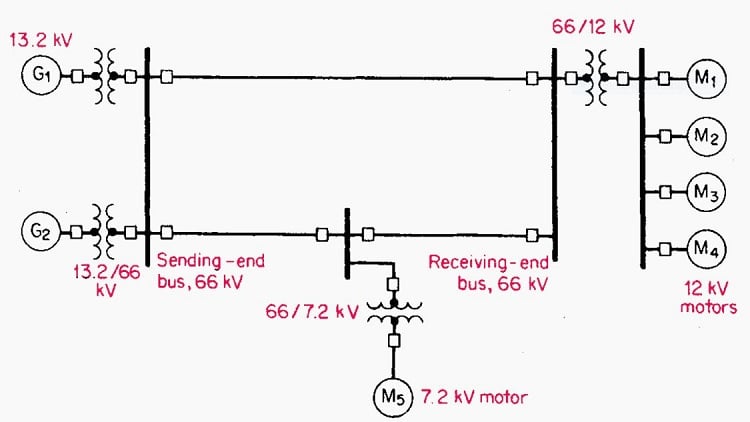 Three-phase power system represented by a single line diagram. Source: Electrical Engineering Portal
Power system analysis is the study of how power grids function. It is a crucial part of building and maintaining reliable electricity grids. To find out how adding additional generation would affect the rest of the power grid, for instance, a utility must perform a power system study. This entails analyzing the effects on voltage and load flow, and implications for system stability. Similarly, power system analysis is used when a utility intends to expand its infrastructure by installing new transmission lines to assess how those lines will interact with the existing infrastructure. Analyzing the power system is simplified using the per-unit (p.u.) system. The power system industry relies heavily on this system for expressing the voltage, current, power and impedance of a wide range of power equipment.
What is a p.u. system?
The p.u. system is a way to standardize the measurement of electrical values. This facilitates power system analysis by allowing for direct comparison of all values. The p.u. value of any quantity (voltage, current, power, impedance, torque, etc.) is the value relative to a base value. The following are the foundational principles of the per-unit system:
- In the electrical industry, all measurements are expressed as a percentage of a base value.
- The base value is chosen such that it works well with the power system under study.
- Typically, the power system's nominal voltage or nominal power output is used as the base value.
These two base values of nominal voltage or power serve as the starting point for the calculation of all others. After settling on the base power and base voltage, the base current and base impedance values are fixed by the rules of electrical circuits.
Calculating p.u. values
Let’s understand this by taking few examples. For instance, if the base voltage and base power values for a certain power system are selected to be 100 V and 1,000 W, then a voltage of 120 V passing through the system would be 1.2 p.u. as per the following formula:
If 20 A current is flowing the same system and we need to calculate its p.u. value, we need to first find out its base value as it is not given. This can easily be calculated by:

Now, the current in p.u. would be 20/10 = 2 p.u.

Advantages of the p.u. system
The p.u. approach offers several benefits over the more common absolute unit system for describing electrical values. Among these benefits are:
- Accuracy: The p.u. method avoids the potential for mistakes that might arise when converting between various units.
- Simplicity: The p.u. approach facilitates power system wide comparisons of electrical quantities.
- Adaptability: This analysis can be used in power grids of varying sizes and complexities, demonstrating the method's adaptability.
Applications of the p.u. system
The p.u. system can be used for doing any kind of power system analysis. For example, they can be useful for:
- Fault analysis: The results of a fault analysis are used to calculate how a short circuit or other fault would affect a power grid. Fault current and potential damage may both be more easily estimated using the per-unit approach.
- Load flow analysis: The steady-state voltage and current distribution in a power system may be calculated by doing a load flow analysis. Since all quantities can be compared directly using the per-unit approach, it facilitates the solution of the load flow equations.
- Economic dispatch: it is used to figure out how to generate power most efficiently in a grid. The cost of power generated from various sources may be more easily compared using the per-unit approach.
[Subscribe to the free Power Grid Technology newsletter from GlobalSpec]
The drawbacks of the p.u. system
Although it is a useful method, this approach has some limitation when applied to power system analysis. Among those are:
- It can be difficult to understand and implement, particularly in big power grids.
- The precision of the p.u. system depends on the reliability of the base values employed. The accuracy of the analysis is compromised by carelessness in selecting the base values.
- Several assumptions, including steady-state operation, underlie the p.u. system. The analyses' validity depends on these assumptions being satisfied.
Conclusion
Power system analysis is essential for building and maintaining reliable electricity grids and is used to assess the effects of adding additional generation and expanding infrastructure. The p.u. system facilitates power system analysis because of its precision, flexibility and convenience in comparing electrical quantities throughout the power grid. Despite its complexity, it is a valuable tool for studying power systems. It is used by the power industry's planners, managers and troubleshooters.