Team upcycles plastic into soap
Marie Donlon | August 16, 2023A team of researchers form Virginia Tech have created a new method for turning plastics into chemicals called surfactants, which are used in the making of soap, detergent and more.
Making this possible, according to the Virginia Tech team, is that the chemical structure of polyethylene — which is a commonly used plastic — is similar to that of fatty acid, which is the chemical precursor to soap. While both materials are composed of long carbon chains, fatty acids reportedly include an additional group of atoms located at the end of the chain.
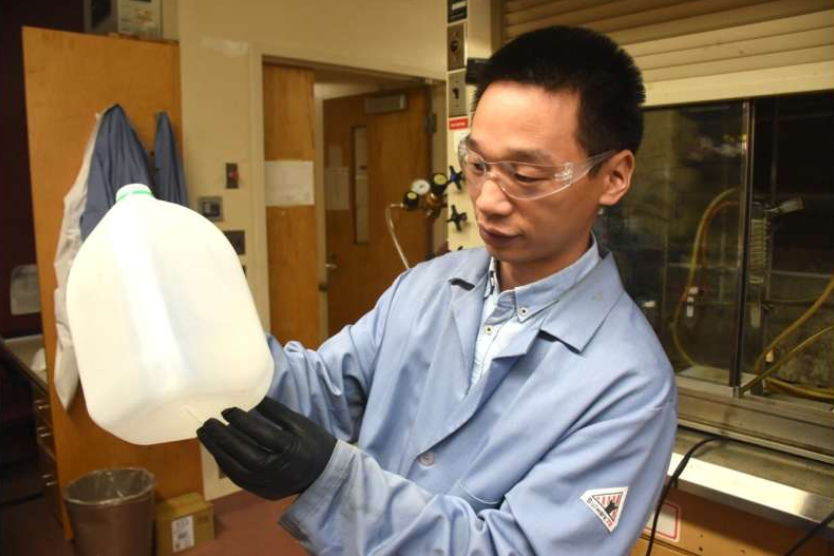 Guoliang “Greg” Liu holds a common water jug in his lab. Source: Steven Mackay/Virginia Tech
As such, the researchers determined that it would be possible to convert polyethylene into fatty acids, and with a few extra steps, to subsequently produce soap.
To do this, the team had to break a long polyethylene chain into many not-too-short chains. Taking inspiration from burning firewood, which produces smoke and leaves behind residue, the team sought to determine if polyethylene burned in a safe laboratory setting would produce smoke and residue.
"Firewood is mostly made of polymers such as cellulose. The combustion of firewood breaks these polymers into short chains, and then into small gaseous molecules before full oxidation to carbon dioxide," explained the researchers. "If we similarly break down the synthetic polyethylene molecules but stop the process before they break all the way down to small gaseous molecules, then we should obtain short-chain, polyethylene-like molecules."
In the lab, the team built an oven-like reactor to heat the polyethylene using a process dubbed temperature-gradient thermolysis.
The researchers explained that the bottom of the oven is at a temperature high enough to break the polymer chains while the top of the oven is at a temperature low enough to discourage further breakdown.
At the completion of thermolysis, the Virginia tech team collected the residue and determined that it featured "short-chain polyethylene," or waxes.
With the addition of a few more steps, like saponification — which is the process of converting esters into soaps and alcohols by the action of aqueous alkali — the team created soap out of plastics — a reported world’s first.
Further, the team discovered that the upcycling method can also work using polypropylene, another common type of plastic. The team also found that the upcycling method can be used on both types of plastics simultaneously, thereby making it unnecessary to separate the two materials from each other as is common in current recycling methods.
An article detailing the new upcycling method, Chemical upcycling of polyethylene, polypropylene, and mixtures to high-value surfactants, appears in the journal Science.