Predicting COVID cases by combining wastewater data with AI
S. Himmelstein | September 15, 2023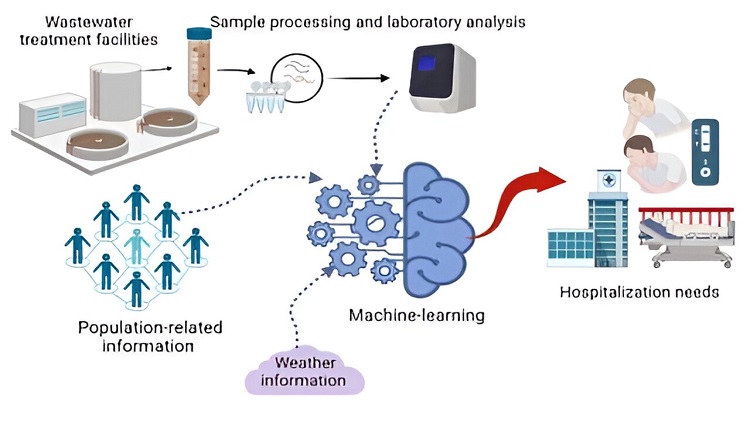 The tool for predicting COVID-19 hospital admissions is based on AI and wastewater sampling data. Source: Xuan Li/University of Technology Sydney
Hospital admission rates of COVID-19 cases can be predicted up to four weeks in advance using a wastewater-based epidemiology (WBE) approach to artificial intelligence (AI) modeling.
An international research group developed the prediction model used wastewater data from 159 counties in 45 U.S. states for the June 2021 to January 2023 period. This information was combined with hospital admission records, vaccination records and weather condition trends to predict county-level hospitalization indicators over the course of the upcoming week, as well as the second, third and fourth weeks after wastewater sampling.
The research published in Nature Communications confirms the feasibility of using WBE to predict county-level weekly new hospitalizations with a lead time of up to four weeks. The early warning capability of WBE for such predictions is attributed to viral RNA shedding from COVID-19 patients to sewers and the transmission of COVID-19 within the population.
Concentrations of the causative virus SARS-CoV-2 in wastewater proved the most crucial explanatory factor, followed by population-health-related information, such as vaccinations, and COVID-19 transmission-related information provided by the COVID-19 Community Vulnerability Index in use by the U.S. Centers for Disease Control and Prevention.
The study conducted by researchers from the University of Technology Sydney (Australia), South East Water (Australia), Morgan State University (Maryland), University of New South Wales (Australia) and Delft University of Technology (Netherlands) demonstrated how wastewater monitoring combined with AI-based modeling can be a cost-effective early warning system. Public health officials can rely on such technology to better prepare for and manage pandemics and efficiently allocate limited healthcare resources.