Partial Water Pipe Replacement Ups Health Risk: Study
Engineering360 News Desk | February 05, 2016A long-term simulation study confirms that partial replacement of lead pipes with copper, similar to what was undertaken in Flint, Mich., and Washington, D.C., more than doubles the lead released into the water supply and increases the risk of lead exposure in humans to harmful levels. Virginia Tech scientists Justin St. Clair, Simoni Triantafyllidou, Brandi Clark and Marc Edwards, and Clement Cartier of Claro Inc., reported the results of a four-year study designed to assess the impacts of three different water service line replacement configurations: (1) using 100 percent lead throughout; (2) the conventional strategy for partial replacement comprising 50 percent copper upstream of 50 percent lead pipe; and (3) 50 percent lead pipe upstream of 50 percent copper.
Elevated lead from corrosion worsened over time for the 50 percent copper configurations, with 140 percent more lead release demonstrated after 14 months, the researchers report. At high flow rates, 100 percent of the samples collected from the conventional partial configurations exceeded health safety thresholds. That compared to 0 percent risk for samples collected from 100 percent lead pipe.
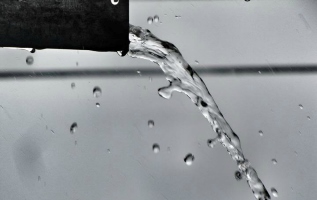 Corrosion between copper and lead water pipes can create a human health risk. Image credit: Morguefile. “This research demonstrates conclusively that if pipe replacements are to be conducted in response to water lead contamination events, such as those that occurred in Washington, D.C., in 2001-2004 or Flint, Mich., in 2014-2015, half measures can create a worse problem than doing nothing,” says Edwards, study coauthor and an international expert on water corrosion in home plumbing.
“Specifically, replacing only the publicly owned portion of the lead pipe with copper can sometimes create an acute health risk due to corrosion arising between the copper and lead," Edwards says. "Utilities and the U.S. Environmental Protection Agency should allow only full replacements or, if partial replacements cannot be avoided, require use of plastic pipes instead of copper.”