Sensor swiftly spots COVID agents in indoor air
S. Himmelstein | August 02, 2023Indoor monitoring of the SARS-CoV-2 virus variants responsible for COVID-19 can be accomplished in real time with a biosensor-based detection system devised by researchers from the National Institute of Neurological Disorders and Stroke, Washington University in St. Louis and Virginia Tech.
The system can be deployed in hospitals, schools and diverse public places to detect these variants in addition to influenza and respiratory syncytial virus aerosols within five minutes.
The instrument is based on a micro-immunoelectrode biosensor previously developed to detect amyloid beta as a biomarker for Alzheimer's disease. The sensor was re-engineered by exchanging the amyloid beta antibody for a nanobody from llamas that recognizes the spike protein from the SARS-CoV-2 virus. This device is then integrated with a wet cyclone technology-driven air sampler configured to trap virus aerosols and automatically send samples mixed with fluid to the biosensor for seamless detection of the virus using electrochemistry.
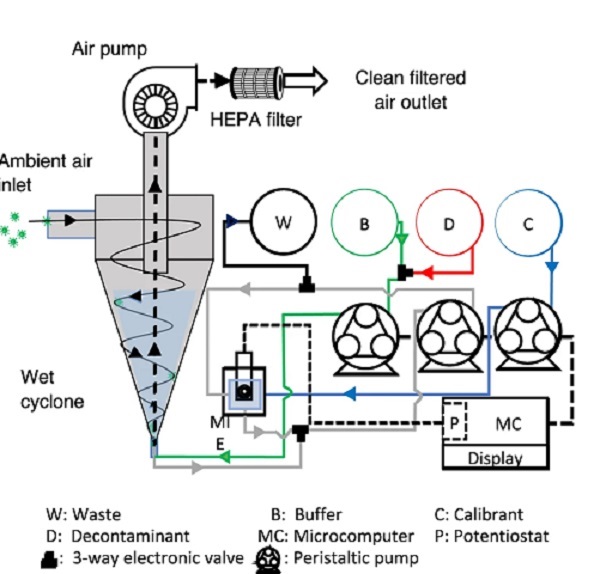 Schematic shows the wet cyclone sampler coupled with the biosensor detection unit. Source: Nat. Commun. 14, 3692 (2023)
A notable feature of the system described in Nature Communications is its extremely high flow rate of about 1,000 liters per minute, making it one of the highest flow-rate devices available. It also lights up when a virus is detected to alert operators of the need to increase airflow or circulation in the room.