Basics of steam turbines
Temitayo Oketola | July 15, 2023In the world of power generation, steam turbines stand as remarkable exemplars of technologies that have stood the test of time. These devices have been around for over a century, helping to meet a significant portion of the world’s energy demand.
Steam turbines convert thermal energy (from superheated steam) into mechanical energy (in the form of shaft rotation). Through the use of a generator, this mechanical energy is then converted to electrical energy. But as simple as steam turbines’ operation might seem, there are several essential components and calculations that guide the design and operation of these amazing devices.
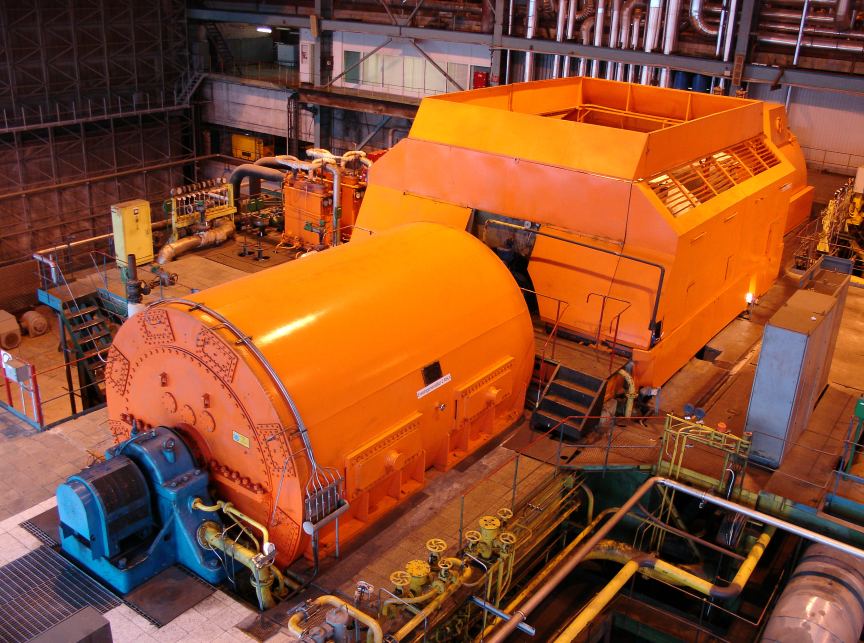 Figure 1: Steam turbines convert thermal energy (from superheated steam) into mechanical energy (in the form of shaft rotation). Source: Andrei Merkulov/Adobe Stock
How do steam turbines work
The working principle of steam turbines is grounded in the laws of thermodynamics and fluid mechanics. The most fundamental law applied is the law of energy conservation, which describes that energy can neither be created nor destroyed but can be converted from one form to another.
A steam turbine is made of several components, including a boiler, turbine, condenser, generator and control valves. Its operation begins with the boiler heating water to produce high-pressure steam. This steam is made to pass through a turbine, impacting the turbine blade. These blades are specially shaped and organized into stages, expanding the steam. As the steam expands within the turbine, its temperature and pressure drop so that its kinetic and potential energy is transferred to the turbine blades, causing the blades to rotate.
The steam turbine is connected to a generator, so that the mechanical energy (from shaft rotation) is converted to electrical energy.
Types of steam turbines
Steam turbines are mainly categorized into two types:
- Impulse turbines
- Reaction turbines
The impulse turbines operate based on Newton’s first law of motion. In these turbines, the high-pressure steam from the boiler is directed toward the turbine blades through nozzles, causing a change in the momentum of the steam. This change in the steam’s momentum results in a force that rotates the blades. The key thing to note is that the pressure of the steam does not change as it passes over the blades; it is the force of the steam hitting the blades that make the turbine spin.
The reaction turbines operate by forcing high-pressure steam through openings in the turbine blades. As the steam leaves, it creates a reaction force in the opposite direction that causes the turbine blades to spin. Unlike the impulse turbine, the pressure and velocity of the steam decrease across the turbine blades, causing them to move.
While impulse and reaction turbines have several unique advantages and strengths, the ideal choice for a particular application depends on several factors, such as the available steam pressure, specific application requirements and efficiency requirements. For instance, impulse turbines are generally used in scenarios where the steam is at very high pressure, but the flow rate is relatively low, such as in small-scale power generation units. In contrast, reaction turbines are best suited for scenarios where steam pressure is moderate but the flow rate is high. Engineers will find them being used in large-scale power generation systems like coal-fired power plants.
Basic efficiency calculation of steam turbines
Steam turbine performance is typically measured in terms of its efficiency. While there are several kinds of efficiencies used to describe the performance of steam turbines, the isentropic efficiency is typically used during the thermodynamic analysis of this system.
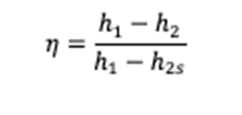
The term “isentropic” is used in thermodynamics to describe an ideal process that occurs without any change in entropy (which is a measure of energy dispersion in a system). Isentropic efficiency is a measure of how well the steam turbine converts the energy in the steam into mechanical work compared to a perfect, ideal turbine. It can be calculated using:
 Motors2
Where:
h1 is the enthalpy of the steam entering the turbine
h2 is the enthalpy of the steam leaving the turbine
h2s is the enthalpy of the steam leaving the turbine, assuming an ideal isentropic process
Conclusion
Steam turbines are important devices helping to convert thermal energy into mechanical energy and then electricity. However, to achieve desirable performance, these turbines must be correctly sized to meet the application requirements. While this article presents the basics of steam turbines, several other factors must be considered when choosing steam turbines for a particular application. Therefore, it is advisable to reach out to steam turbine manufacturers to discuss application requirements.