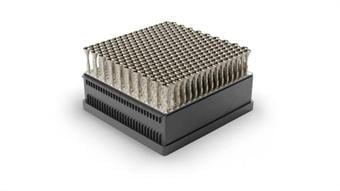
3D-Printed Hypersonic Engine Combustor Successfully Tested
By Engineering360 News Desk | February 04, 2016Orbital ATK has tested a 3D-printed hypersonic engine combustor at NASA Langley Research Center.
The combustor, produced through an additive manufacturing process known as powder bed fusion (PBF), was subjected to a variety of high-temperature hypersonic flight conditions over the course of 20 days. The tests included one of the longest-duration propulsion wind tunnel tests for a unit of this kind. Analysis confirms the unit met or exceeded all of the test requirements.
Hypersonic vehicles are defined as those able to reach speeds equal to five times the speed of sound.
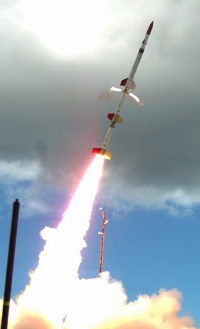 NASA and the U.S. Air Force Research Laboratory are testing hypersonic vehicle technologies. Image credit: AFRL.A scramjet combustor is one of the critical components of the propulsion system, responsible for housing and maintaining stable combustion within a volatile environment. According to the company, the tests were aimed, in part, to ensure that the PBF-produced part would be robust enough to meet mission objectives.
“Additive manufacturing opens up new possibilities for our designers and engineers,” says Pat Nolan, vice president and general manager of Orbital ATK’s Missile Products division. “This combustor is a great example of a component that was impossible to build just a few years ago."
Complex geometries and assemblies that once required multiple components can now be simplified to a single, more cost-effective assembly. However, because the components are built one layer at a time, it is now possible to design features and integrated components that could not be easily cast or otherwise machined.
Final assembly of the test combustor was completed at the company’s facilities in Ronkonkoma, New York, and Allegany Ballistics Laboratory in Rocket Center, West Virginia.