Researchers stick it to surfaces
Marie Donlon | July 17, 2023Scientists from Tsinghua University in China have developed an approach for applying a liquid metal coating to surfaces that do not bond easily with liquid metal.
With possible applications in wearable testing platforms, flexible devices and soft robotics, the new approach could potentially transform a variety of surfaces — paper, plastic and more — into electronic smart devices.
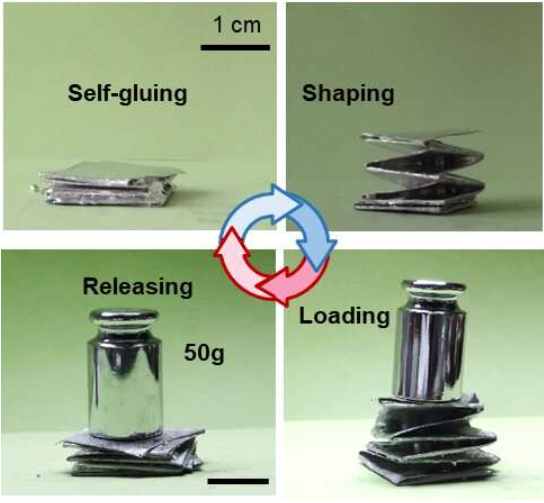 A multifunctional origami structure built by the liquid metal-treated paper. Source: Cell Reports Physical Science/Yuan et al.
Past attempts to overcome the challenge previously encountered when attempting to combine liquid metal with traditional materials, wherein liquid metal's high surface tension prevents it from binding with most materials, have included the addition of more materials. However, the addition of even more materials could potentially weaken the final product's electrical, thermal or mechanical performance.
As such, the researchers explored a different approach, which allowed them to directly print liquid metal on substrates without impacting the metal's properties, by applying two different liquid metals — eGaln and BilnSn — to different silicone and silicone polymer stamps. The researchers then applied various forces by rubbing the stamps onto paper surfaces.
Rubbing the liquid metal-covered stamp against the paper with a minimal amount of force allowed the metal droplets to bind to the surface. Applying greater amounts of force had the opposite effect, preventing the droplets from staying fixed in place.
Further, to demonstrate that the metal-coated paper didn’t lose its typical properties, the team folded it into a paper crane.
Going forward, the researchers are still trying to determine how to keep the liquid metal coating in place after application and are currently using a packaging material added to the paper's surface.
"Just like wet ink on paper can be wiped off by hand, the liquid metal coating without packaging here also can be wiped off by the object it touches as it is applied," explained the researchers. "The properties of the coating itself will not be greatly affected, but objects in contact may be soiled."
The approach is detailed in the article “Direct Fabrication of Liquid Metal Multifunctional Paper Based on Force Responsive Adhesion,” which appears in the journal Cell Reports Physical Science.