
The global warming impact of hydrogen
S. Himmelstein | July 18, 2023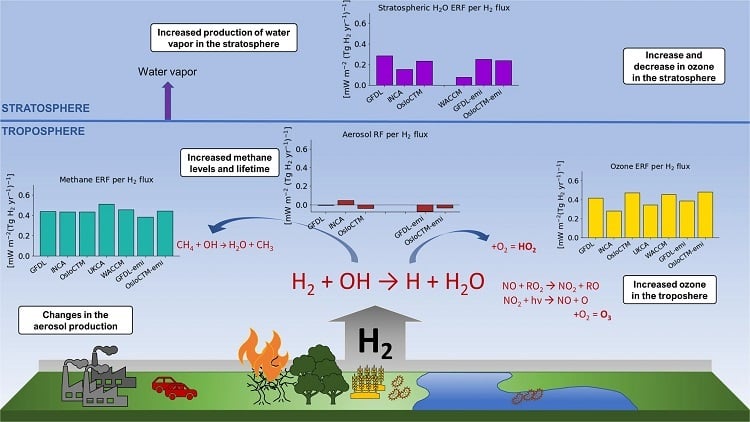 The main changes in radiative forcing due to 1?terragram (Tg) flux of hydrogen; methane (green bars), ozone (yellow), stratospheric water vapor (purple) and aerosols (red). Source: Commun Earth Environ, 4, 203 (2023)
The increased consumption of hydrogen is advocated by environmental scientists as a substitute for fossil fuels that contribute to global warming by releasing carbon dioxide. While hydrogen combustion releases only water vapor and oxygen, it can be a contributor to climate modification due to leakage during production, transportation and usage that adds to global warming.
The chemical reactions of hydrogen in the atmosphere affect greenhouse gases such as methane and ozone. In this way, emissions of hydrogen can cause global warming despite its lack of direct radiative properties, according to a comprehensive assessment of the climate effect of hydrogen conducted by an international team of researchers.
Five different atmospheric chemistry models were analyzed to examine changes in atmospheric methane, ozone and stratospheric water vapor. The study considered hydrogen interactions with various biogeochemical processes, including uptake, photochemical production of hydrogen, greenhouse gas lifetimes and the interactions between hydrogen and methane.
The research published in Nature Communications Earth & Environment indicates that the 100 year time horizon global warming potential (GWP100) of hydrogen is twice as high as earlier estimates. The global warming effect of leaked hydrogen is almost 12 times stronger than that of carbon dioxide.
With a GWP100 of 11.6, the potential benefit of switching to a hydrogen economy will depend on hydrogen leakage rates and to what extent hydrogen replaces fossil fuels.
Researchers from CICERO Center for International Climate Research (Norway), University of Edinburgh (U.K.), rdscientific (U.K.), Université Paris-Saclay (France), U.S. National Oceanic and Atmospheric Administration and the University of California Irvine contributed to this study.


I don't believe this will be an issue...hydrogen leakage will be a small amount, and will likely mostly escape the Earth to space...