Autonomous robot promises to stave off spotted lanternflies
Marie Donlon | June 28, 2023Researchers from Carnegie Mellon University have built an autonomous robot for controlling the spread of spotted lanternflies — invasive insects capable of destroying crops.
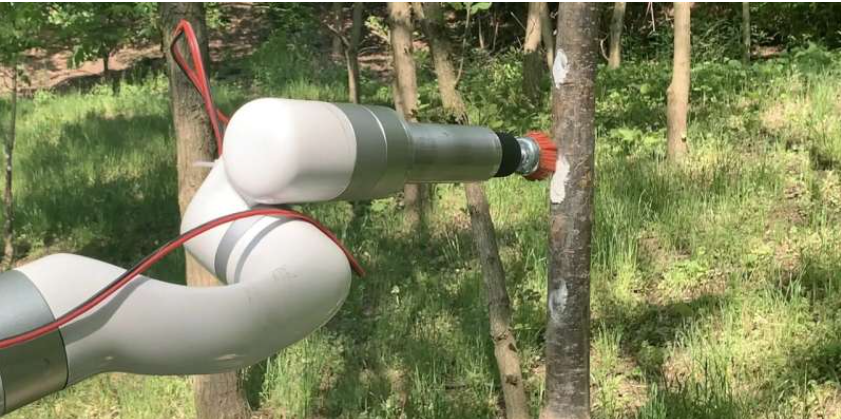
The TartanPest robot is comprised of an all-electric tractor, a robotic arm and computer vision, which enables the robot to navigate fields and forests to locate and destroy spotted lanternfly egg masses. These egg masses — which can be found on trees, outdoor furniture, rusted metal surfaces and rocks, among other objects — can contain anywhere from 30 to 50 eggs each.
 Source: Carnegie Mellon University
To build the TartanPest, the researchers mounted a robotic arm to the base of an all-electric Amiga microtractor developed by robotics company Farm-ng. Further, TartanPest employs a deep learning model trained on an augmented image data set built from roughly 700 images of spotted lanternfly egg masses, which enable the robot to identify and scrape them off surfaces.
Although the spotted lanternflies are concentrated in the eastern segment of the U.S. — where they are laid in the fall and hatch in the spring — they are expected to eventually spread throughout the country.
For more on the TartanPest, watch the accompanying video that appears courtesy of Carnegie Mellon University.