Bonding material braces perovskite solar cell performance
S. Himmelstein | June 05, 2023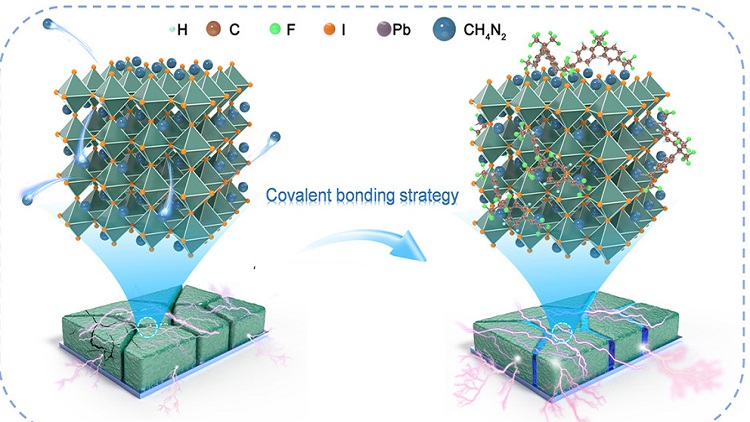 The bonding material preserves the integrity of PSCs. Source: Joule.2023.03.019
Perovskite solar cells (PSCs) have emerged as a lower cost and efficient alternative to conventional silicon solar cells, but their long-term stability under environmental conditions impedes commercialization. Volatile organic components escape or migrate from the perovskite layer under exposure to heat and sunlight, causing degradation and a reduction in PSC stability and performance.
A molecular crosslinker designed and manufactured by Canadian specialty chemical company XlynX Materials has been demonstrated to effectively protect these solar cells from such deterioration. The bonding strategy relies on bis-diazirine molecules to covalently bond with organic cations and prevent the loss of PSC organic components.
Treated cells retained almost 99% of their initial efficiency after 1,000 hours of continuous exposure to simulated sunlight. By comparison, untreated solar cells lost 35% of their original efficiency under the same conditions and over the same time frame. After exposure to constant heat of 60° C for 600 hours, the stabilized devices retained almost 98% of their efficiency while the control group lost 27%.
In addition to enabling highly efficient and ultra-stable PSCs, the bonding system described in Joule may offer similar benefits in other perovskite-based optoelectronic applications.
Researchers from Fudan University (China), University of Victoria (Canada), Suzhou University of Science and Technology (China), Central South University (China), East China Normal University, Chinese Academy of Sciences and University of Vienna (Austria) participated in this study.