The circular economy is reshaping the electronics industry
N. Mughees | August 16, 2023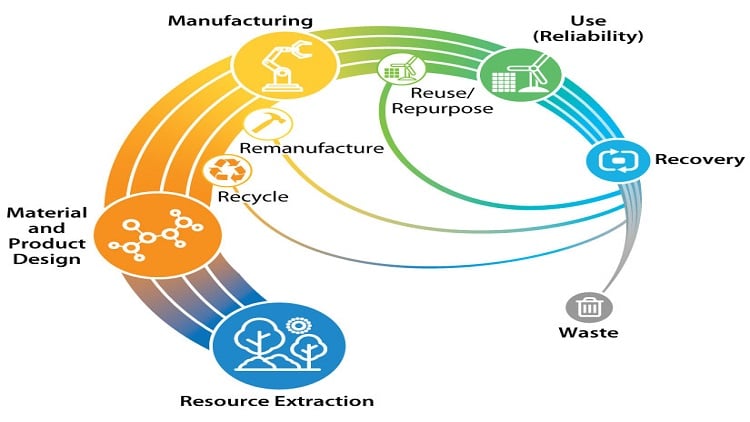 Source: U.S. National Renewable Energy Laboratory
A circular economy is an alternative economic system, based on the principles of closed-loop production and consumption, where materials are kept in use for as long as possible. It offers an alternative way of doing business in the electronics sector by rethinking how we design, manufacture, use and recycle electronic products. It can create a closed-loop production and consumption system, reduce resource use and waste, and lead to more responsible manufacturing and consumption practices. By integrating circular strategies into the production, use and reuse of electronics, consumers and manufacturers can ensure that their products are designed with repairability in mind and recycled when no longer useful. This creates a circular economy for electronics that is sustainable, financially beneficial, and most importantly, kind to the planet.
How does a more circular economy help the electronics industry?
- New products are designed to be reused, repaired or remanufactured when they reach the end of their lifecycle.
Manufacturing processes use fewer resources, and all materials are tracked throughout the product’s life cycle so that every component can be reused, recycled or recovered for future applications. Producers of electronic devices are also incentivized to take back their products when customers are done using them so that components can be reused in the production of new items or for other purposes.
- Products and their parts are used for longer periods of time, and their lifecycles are extended to reduce the amount of material that is wasted.
By building strong reuse options into the design of electrical devices and their parts, like repair, resale, refurbishment and remanufacturing, waste streams may be slowed down and items can be used for a longer time. This helps manufacturers and consumers alike, as companies can maximize the return on investment for their products, and customers can purchase items with greater longevity.
- Materials that are no longer useful are collected and recycled in a quick and easy way.
Products that have reached the end of their useful life cycle are collected, sorted and recycled according to responsible procedures and standards that promote climate action, decent job, and a just transition. This helps to reduce greenhouse gas emissions by extending the lifecycle of products, promoting a circular economy with Net Zero carbon emissions. These initiatives demonstrate a commitment to sustainability by eliminating the possibility of e-waste being sent to landfills or incinerators, which can lead to environmental contamination and health risks.
[Stay up to date on sustainability news: subscribe to the free Environmental Technology newsletter from GlobalSpec]
What are some business models for the circular economy in electronics?
Organizations may increase their resource efficiency by reusing and recycling goods, components and resources by coordinating their value chains. This can include material collection and reverse logistics, material sorting and reprocessing, and electronics reuse, sharing and repair.
- Use electronics as a function, where users pay for a certain function rather than for the technological device or product itself. Washing machines, for instance, may be rented on a pay-as-you-go basis; the company's fees are based on how much the service is used and always includes maintenance. This kind of practice helps reduce resource consumption by discouraging consumers from buying new products and thereby cutting down on the generation of waste.
- Renting electronics instead of buying. This allows for a more circular approach to technology reuse, which in turn benefits customers by making more cutting-edge and costly technology more affordable and accessible. For instance, companies may provide consumer devices including PCs, video game consoles and electric scooters on a subscription basis.
- Making smart products. Modularity, ease of disassembly and repairability are all ways to make things last longer in the field. A modular architecture, for instance, makes it simple to replace or update any of the phone's easily available parts in the event of damage or obsolescence. The trend toward modularity and repairability helps prolong the life of the product by ensuring that a single malfunctioning component does not mean an entire system needs to be replaced.
- Reuse. Even while there has been some widespread adoption of return, refurbishment and resale practices in the electronics industry, there is still a lot of room for improvement. There is an opportunity for businesses to elevate the used consumer device market and increase consumer trust and confidence, similar to the experience of purchasing a used car from a reputable brand dealership. Currently, the majority of used consumer devices are sold informally, through online platforms such as eBay. For example, some companies are allowing users to trade in their old phones to be reconditioned and resold with a new 12-month guarantee.
Conclusion
The circular economy is a viable alternative to the traditional linear economy, which is characterized by a 'take-make-dispose' approach and can significantly reduce the amount of waste that enters landfills. With a circular economy, consumers are incentivized to use products responsibly and efficiently since they pay for the function rather than the product while also encouraging the reuse of products. Washing machines rented on a pay-as-you-go basis are just one example of how a circular economy can help reduce resource consumption by minimizing the need to purchase new products and thus reducing the amount of waste produced.