Cooling solar cells with water
S. Himmelstein | June 02, 2023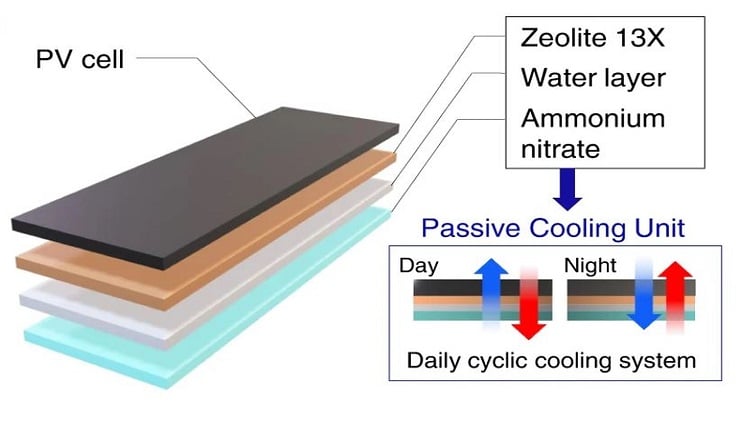 Passive cooling is provided by water desorption and endothermic reaction dissolution processes. Source: Nature Communications (14), 2374 (2023)
An efficient passive cooling system for solar panels uses water desorption and endothermic reaction dissolution processes. The inexpensive system consumes no energy and features self-recovering properties.
The atmospheric water desorption-driven cooling system uses Zeolite 13X, a commercially available alumino-silicate material, to desorb water molecules and produce a latent cooling effect. When heat is applied, water is desorbed from Zeolite 13X and dissolves ammonium nitrate to induce endothermic reaction cooling, resulting in a reversible process that recovers itself at night.
The water-based cooling system absorbs heat from solar radiation and desorbs the solvent, which generates secondary cold energy. The cooling effect is achieved because the water adsorption capacity of the zeolite is inversely proportional to temperature, and water can dissolve more ammonium nitrate at higher temperatures.
To test the cooling system, a urethane-waterproofed solar cell was coated with water-saturated Zeolite 13X particles, after which an ammonium nitrate crystal layer was applied to form a thin film. The water desorption structure had an average effective heat transfer coefficient of 64.1 W/m2. Thermal imaging confirmed that the surface temperature of the solar cell was 39° C to 43° C, which was significantly lower than that of natural air cooling (51° C to 56° C). As reported in Nature Communications, the average temperature of the cell was reduced by 14.9° C.
Scientists from Research Center for Plus Energy Building Innovative Technology (South Korea), University of California Berkeley and Korea Maritime and Ocean University (South Korea) participated in this research.