
Cactus inspires solution to prickly electrolysis problem
S. Himmelstein | June 26, 2023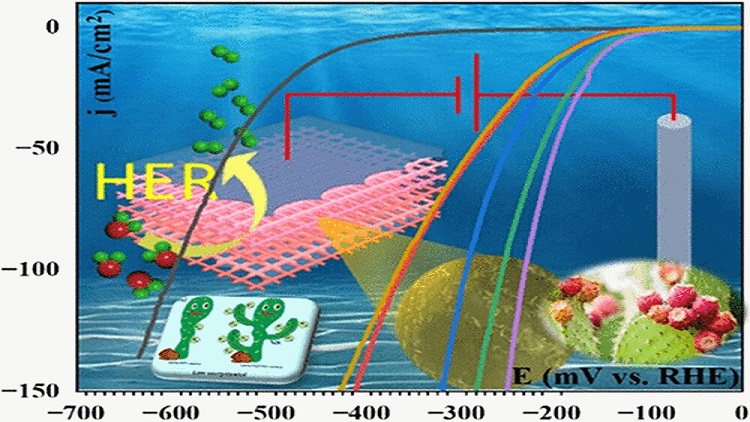 The cactus-inspired nanostructure proved an efficient hydrogen evolution reaction (HER) catalyst. Source: ACS Applied Materials & Interfaces (2023). DOI: 10.1021/acsami.3c00781
Researchers have been intent on replacing pricy platinum catalysts with cheap and abundant materials to boost the cost-effectiveness of hydrogen production via electrolysis. Emphasis has been placed on the use of relatively inexpensive nickel, although this metal is not nearly as efficient a catalyst as platinum. Taking a cue from the local flora, an opportunity to enhance the water-splitting prowess of nickel blossomed for University of Texas at El Paso researchers.
Noting the large surface area of the prickly pear relative to other plants, the team sought to design a 3D nickel-based catalyst in the shape of this succulent. A larger surface area could accommodate more electrochemical reactions and generate more hydrogen than nickel typically can. A new nanoscale structure composed of nickel, phosphorus and sulfur nanosheets and plates was synthesized to mimic the role of leaves and fruits in the prickly pear cactus.
The new catalytic structure demonstrated greater capacitance, lower charge transfer resistance and acceleration of electron exchangeability relative to a nickel phosphide catalyst. The novel design was also observed to offer an expanded active catalytic surface area and to elevate intrinsic catalytic activity by introducing heterointerfaces, thereby increasing the efficiency of hydrogen production.,
Researchers from U.S. Pacific Northwest National Laboratory and University of Pittsburgh also contributed to this study, which is published in the journal ACS Applied Materials & Interfaces.



Could the Nickel-Alkaline or Edison batteries benefit from this type of structure. Could it reduce the volume of the plates in the battery's and make them lighter and more cost effective