Tiny but mighty 100-year biobattery
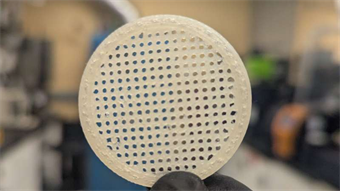
S. Himmelstein | June 06, 2023 The dime-sized biobattery potentially has a 100-year shelf life. Source: State University of New York at Binghamton
A biobattery that is safe to swallow and power ingestible cameras was recently developed by researchers from the State University of New York at Binghamton. The knowledge gained from this advance has been applied to the design of another battery system based on the use of spore-forming bacteria to fuel low power electronics outside the body.
[See also: Biobatteries designed to power ingestible medical devices]
An incredibly long shelf life is a major attribute of this microbial fuel cell device, which is reported to produce power even after 100 years.
“The overall objective is to develop a microbial fuel cell that can be stored for a relatively long period without degradation of biocatalytic activity and also can be rapidly activated by absorbing moisture from the air,” said Professor Seokheun Choi. “We wanted to make these biobatteries for portable, storable and on-demand power generation capabilities. The problem is, how can we provide the long-term storage of bacteria until used? And if that is possible, then how would you provide on-demand battery activation for rapid and easy power generation? And how would you improve the power?”
The dime-sized fuel cell contains nutrients and heat-activated Bacillus subtilis spores as a dormant biocatalyst that can survive long storage durations. When a heat-resistant sealing tape is removed, moisture is allowed in and transports the nutrients to the spore to activate their growth and electrocatalytic activities.
During testing, heat activation of the bacterial spores was observed to cut the time to full power from 1 hour to 20 minutes, and raising the humidity resulted in increased electrical output. After a week of storage at room temperature, only a 2% drop in power generation was recorded.
As reported in the journal Small, the biobattery produced a maximum power density of 0.4 mW/cm2 and a maximum current density of 2.2 mA/cm2.