Biosensor technology promises to bring mind control one step closer
Marie Donlon | March 27, 2023Researchers from the University of Technology Sydney (UTS) have created biosensor technology that will enable operators to control devices such as robots and other machines via mind control.
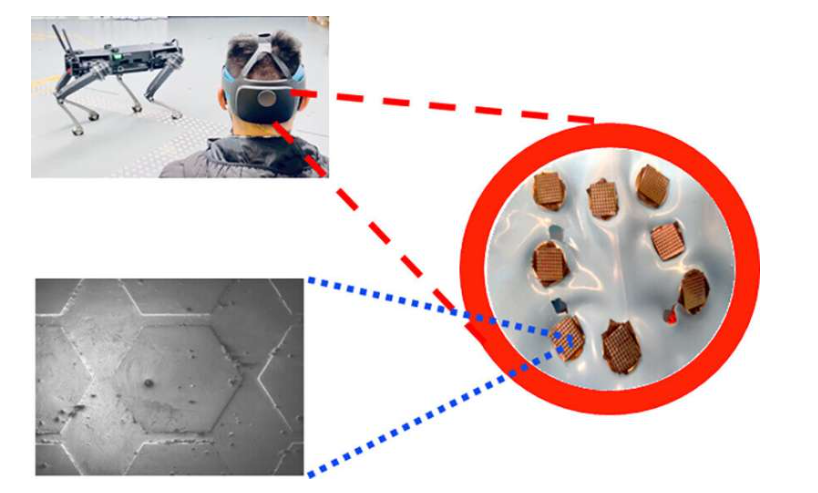 Source: University of Technology Sydney
To create dry wearable sensors for the Advanced Brain Computer Interface and overcome issues of corrosion, durability and skin contact resistance, the researchers used graphene and combined it with silicon.
The sensors, which are hexagon patterned, are placed over the back of the scalp where they detect brainwaves from the visual cortex. Further, a head-mounted augmented reality (AR) lens that displays white flickering squares is worn by the user. As the user concentrates on a specific square, his or her brainwaves are detected by the biosensor while a decoder translates those signals into commands.
The Advanced Brain Computer Interface could potentially be used in defense, manufacturing, aerospace and healthcare applications.
Soldiers from the Australian Army recently trialed the technology by operating a Ghost Robotics quadruped robot via the brain-machine interface. The device enabled users to have hands-free command over the robotic dog with up to 94% accuracy.
"Our technology can issue at least nine commands in two seconds. This means we have nine different kinds of commands and the operator can select one from those nine within that time period," the researchers said. "We have also explored how to minimize noise from the body and environment to get a clearer signal from an operator's brain."
An article detailing the technology, “Noninvasive Sensors for Brain–Machine Interfaces Based on Micropatterned Epitaxial Graphene,” appears in the journal ACS Applied Nano Materials.