See videos and 3D images snapped by this gigapixel microscope
S. Himmelstein | April 05, 2023A new computational microscope designed by researchers from Ramona Optics Inc. (North Carolina), Duke University and University of California San Francisco offers a powerful tool enabling experimental observations from the cellular level to the behavior of individual organisms. The high-speed, 3D, gigapixel 3D-RAPID instrument is a multi-camera array microscope incorporating 54 different lenses that capture a subject from slightly different angles.
The images captured by the 3D-RAPID system are stitched together by means of a 3D reconstruction algorithm to create one large image with a resolution on the gigapixel scale. In addition to recording 3D measurements, the microscope provides greater detail at smaller scales relative to comparable instruments and generates clear videos of the subjects under observation.
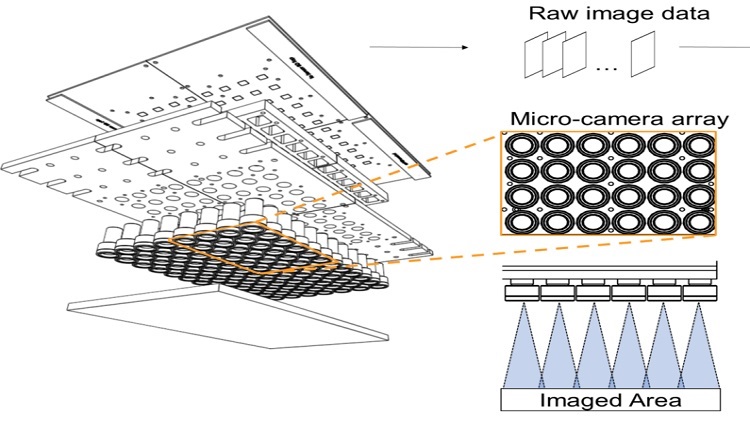 The array of miniaturized digital microscopes acquires synchronized video in parallel. Algorithms fuse the video data into final gigapixel-scale composites. Source: Duke University
The system described in Nature Photonics has been used to monitor zebrafish for drug-induced behavioral changes in a pharmaceutical study and to examine the evolution of fish larvae at the cellular level. The 3D-RAPID tool is expected to find diverse applications outside of the biology realm: One of its early licensers, MIRA Imaging, is using the technology to “fingerprint” fine art, collectables and luxury goods to inoculate against forgery and fraud.