Team creates paper airplane-making robot
Marie Donlon | March 22, 2023Engineers from the Swiss Federal Institute of Technology Lausanne have developed a robotic arm that can design, build and launch paper airplanes.
The researchers have automated the trial-and-error process of finding the appropriate design for paper airplanes, accomplishing the goal of both increasing flight time and distance.
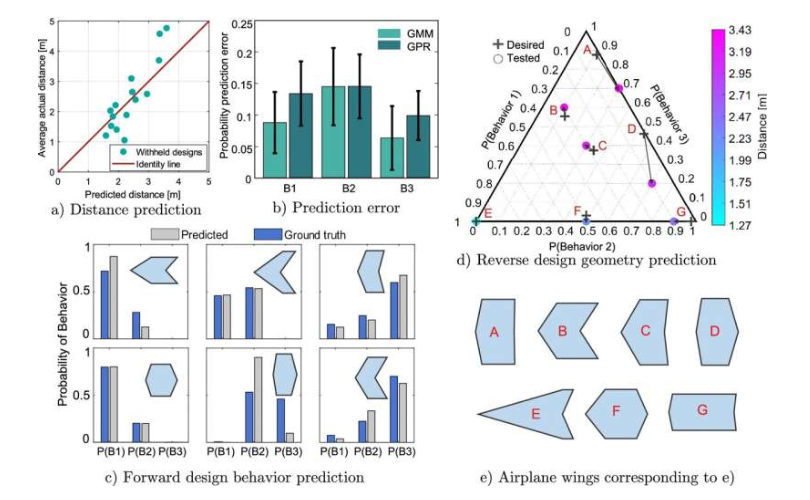 (a) Comparison of average actual distance from experimentation to the predicted distance for airplane designs withheld from the model. (b) Comparison of absolute average error of probability prediction for all withheld airplane designs between the GMM-assisted method and GPR. (c) Forward design behavioral probability prediction of a sample of wings held out from the model compared to its "ground truth" behaviors. (d) Reverse design behavior prediction for chosen target probabilities with corresponding average flight distances. (e) Airplane geometries that are predicted to display the target behavioral probabilities in reverse design. Source: Scientific Reports (2023). DOI: 10.1038/s41598-023-31395-0
To enable the robotic arm to design, build and launch the paper airplanes, researchers first developed a software application for creating the plans for paper airplane construction. Following completion of the design phase, the system’s accompanying app sends the plan to a robot arm that draws and/or cuts out the plan from a single sheet of paper. The robot arm then folds the paper, once the plane is cut out, into an appropriate shape and places it on a device that launches the finished paper airplane across a test pad.
To examine the relationship between airplane design and performance, the researchers set up a camera to capture footage of all the flights and then performed a statistical analysis using the footage captured of roughly 500 different planes and their flights.
Following an analysis of the footage, the team discovered a pattern, noting that each of the flights fell into one of three categories — nose-dive, glide and recovery glide.
By automating these test flights, the researchers suggest the technology could one day be applied to real-world aircraft design.
An article detailing the robotic arm, “Robotic automation and unsupervised cluster assisted modeling for solving the forward and reverse design problem of paper airplanes,” appears in the journal Scientific Reports.
For more on the robotic arm, watch the accompanying video that appears courtesy of the Computational Robot Design & Fabrication Lab (CREATE Lab) at the Swiss Federal Institute of Technology Lausanne.