Purdue's "talking" concrete communicates real-time concrete conditions
Marie Donlon | March 25, 2023Researchers from Purdue University have developed a technique that would enable concrete roadways to “communicate” their condition with engineers.
Often, concrete roadways, which are largely considered the most challenging road material to repair, are vulnerable to premature failure. This is due in part to the veritable guessing game surrounding whether the concrete has reached maturity and thus achieved its full strength.
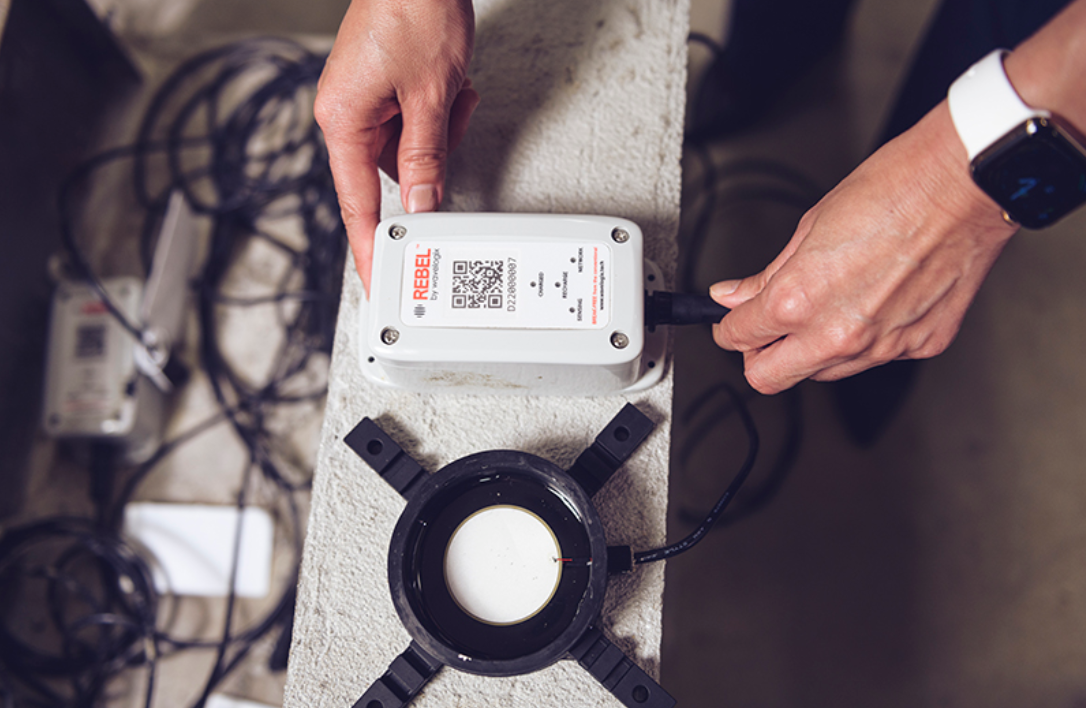 Source: Purdue University
As such, the Purdue team has determined that adding sensors to concrete pours could effectively communicate the condition of the concrete, in real time, to engineers.
The Purdue teams suggests that embedding sensors into concrete could reduce construction times and the frequency of road repairs because the sensors can consistently deliver data about the strength of the concrete such as when it reaches the appropriate strength for accommodating traffic loads following construction. Consequently, recently repaired or constructed roads can open sooner, thereby reducing traffic jams and, subsequently, reducing the carbon dioxide emissions from idling vehicles awaiting construction-related traffic jams.
The team is already testing out the sensors on concrete roadways throughout the U.S. where sensors have been added to concrete pours and sensor cables have been plugged into handheld devices that instantly and automatically log data and communicate that data to engineers via corresponding smartphone apps.
Currently, concrete roadway testing occurs in the lab where slabs of concrete are observed by engineers who make estimations about the material’s strength. However, the sensor approach is expected to outperform this technique as it reveals concrete conditions under outdoor, real-world environments.