ECI solves MRO chromium contamination problem with 900 series monitor/controllers
Engineering360 News Desk | February 16, 2023A U.S. Federal Aviation Administration (FAA) Certified Part 145 repair station maintenance, repair, and overhaul (MRO) facility was unable to discharge to their publicly owned treatment works (POTW) because the hexavalent chromium (Cr(VI)) concentration in their wastewater stream was over the regulated discharge limit. The manager of the facility called Electroplating Consultants International (ECI), a Myron L Company distributor, to solve the problem. ECI provides expert consultation and technical assistance to remediate and optimize metal finishing operations throughout the U.S.
Cr(VI) is a regulated contaminant in drinking water because it can cause gastrointestinal, liver and developmental toxicity in humans when ingested. The U.S. Environmental Protection Agency drinking water standard for total Cr, which includes Cr(III) and Cr(VI), is 0.1 mg/L or 100 parts per billion. Because most POTWs are not equipped to remove Cr from sewage, they rely on industry compliance with effluent permit limits to prevent discharge contamination of surface waters. This prevents subsequent Cr breakthroughs at drinking water treatment plants. The MRO effluent discharge limit for Cr(VI) is a stringent 1 mg/L or 1 part per million, which is effectively no Cr(VI).
Cr(VI) is an unavoidable waste product when refurbishing and manufacturing heat exchangers for aircraft using chemical conversion coatings approved by the FAA. The MRO uses a formulation of BONDERITE found in the Qualified Product List of products under performance specification MIL-DTL-81706 Chemical Conversion Materials for Coating Aluminum and Aluminum Alloys, as indicated by the FAA. Cleaned and prepared heat exchangers are dipped into the Cr(VI)-based BONDERITE (known as ALODINE) solution to dissolve and displace aluminum at the very surface with chromate. This passivated layer provides corrosion protection and improves paint adherence post process. Because the heat exchangers are comprised of many thin tubes, they retain a large amount of this solution after processing such that there is a tremendous amount of carryover of Cr(VI) into the rinse tanks.
The rinse-tank wastewater then must be treated to comply with discharge limits imposed on the MRO. Here Cr(VI) cannot be removed by conventional hydroxide precipitate methods. Instead, a reduction step is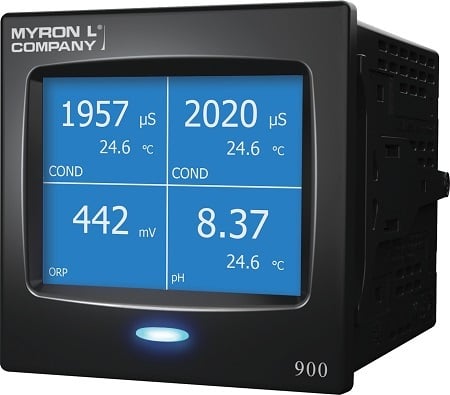 Source: Myron L Company required to convert all Cr(VI) into Cr(III). The reduction is visible as the solution changes from a reddish brown to a blue green. At this point the chromate active sites are accessible, and the Cr(III) is complexed with three sodium hydroxide molecules forming a metal hydroxide micelle. The addition of a small amount of polymer increases the weight of the micelle and allows it to settle in a clarifier. The wet sludge is then removed via an air-operated diaphragm pump and put through a filter press, which makes a cake of the solids and squeezes out all remaining water. This clean water goes back into the process tank for processing, and the cake is hauled off and disposed of.
ECI immediately identified sloppy dosing by existing controllers and excess polymer and bisulfite treatment as problems for the MRO. ECI selected Myron L Company 900 series controllers for both pH and oxidation reduction potential (ORP) control based on experience with their high degree of accuracy and reliability. The units were also manufactured to the standard ¼ DIN size shared by the old controllers making control panel replacement easy. Myron L was able to overnight the units for a Saturday delivery so installation could be completed the following Monday morning.
Sodium hydroxide concentration was then regulated via pH control between 7.5 to 8, and bisulfite addition was regulated via ORP control between 130 mV to 140 mV. Cr(VI) levels were immediately reduced to 0.96 ppm with haul-offs and recirculation no longer needed.
ECI then incorporated additional changes using innovative chemistry that enabled the MRO to reduce caustic and sulfuric usage while eliminating the need for standard bisulfite treatment. This immediately made working conditions safer for the MRO’s employees.
The solid waste generated by the new chemistry is lower in volume than that generated by the bisulfite, more stable, and anticipated to pass a Toxic Characteristic Leachate Procedure (TCLP).
The MRO continues to maintain compliance with their discharge limits, and their most recent Cr concentration test indicated a negligible 0.013 ppm.