Byproduct asphaltene becomes graphene
S. Himmelstein | February 01, 2023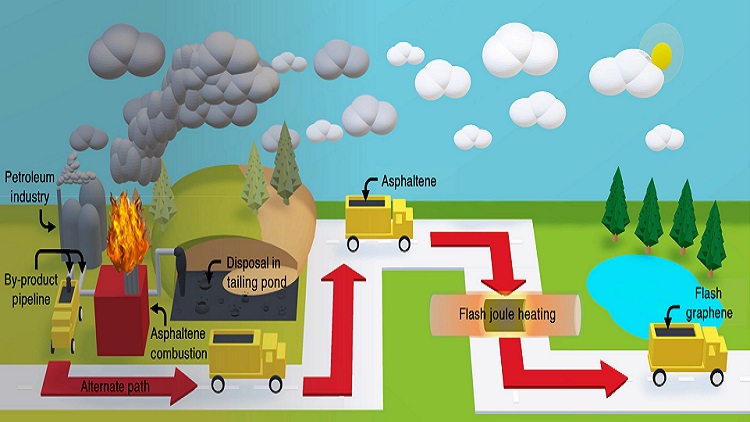 Conceptualization of the sustainable use of asphaltene. Source: Muhammad M. Rahman et al.
Asphaltenes produced during petroleum distillation are deemed as low-value by-products with little to no real-world application and commercial use, and typically end up being burned or landfilled. A more sustainable fate for this carbon-rich material has been devised by researchers from the University of Calgary, Canada, and Rice University. The low-value material is converted into asphaltene-derived flash graphene (AFG) by means of flash joule heating.
As this heating process requires the source material to be electrically conductive, and because asphaltene is a poor conductor, a minimal amount of conductive carbon black is added to the raw asphaltene powder. The conductive homogeneous mixture is then lightly compressed inside a quartz tube between two copper electrodes. High-voltage electric discharge from a capacitor bank brings the source mixture to temperatures higher than 3,000 K in less than 100 ms, effectively producing AFG with a process yield of ~45% and an AFG yield above 95%.
As reported in Science Advances, the AFG was successfully tested as a reinforcement in a value chain of high-performance nanocomposites, which can be used in various applications ranging from structural and thermal to anticorrosion coating. The cost of producing this material was also confirmed to be markedly lower than graphene synthesized by chemical vapor deposition and other more conventional methods.