3D Printing to Control Energy Released by Reactive Materials
Engineering360 News Desk | January 11, 2016Scientists at the Lawrence Livermore National Laboratory (LLNL) and Harvard University are using 3D printing to control the energy released by reactive composite materials. The approach may offer the potential to improve the safety and reliability of air bags, ejector seats and other items that require a quick burst of power. Energetic materials are used in products and applications from gas generators to starter cartridges to fireworks. However, a drawback has been the unpredictability of their reactions.
Historically, the way to alter the performance in reactive materials (also known as thermites) has been to change either the formulation or the change parameters, such as particle size, within a formulation. Now, through 3D printing, LLNL and Harvard University scientists have found that the architecture can play a role in exerting more control over the energy release rate of reactive composites.
“3D printing has allowed us to make high-quality parts with the feature sizes commensurate with the length scales of dynamic phenomena,” says LLNL staff scientist Kyle Sullivan. “It’s allowed us to make precision geometries, with careful control over several length scales. With this spatial control, we wanted to examine how, and to what extent, this translates into controlling dynamic behavior.”
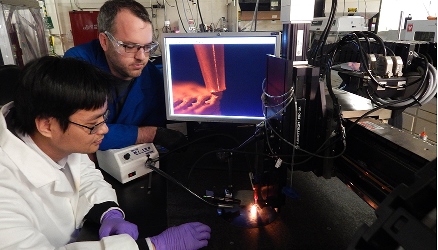 LLNL's Cheng Zhu (left) and Kyle Sullivan used additive manufacturing to print custom electrically conductive substrates. Image credit: LLNL. Through a 3D printing process called direct ink writing, the researchers first constructed 3D conductive electrodes. Then, through another printing process called electrophoretic deposition (EPD), the team coated the surface of the conductive micro-architectures with a composite film of thermite nanoparticles. They found that by creating the reactive material architectures, or RMAs, they could direct and manipulate the energy released by the material in ways that previously were not possible.
“The big message here is we’re showing 3D printing can be used to change the dynamic behavior of materials,” Sullivan says.