Turtle-inspired robot morphs its limbs according to its environment
Marie Donlon | October 17, 2022A turtle-inspired robot capable of transforming its legs into flippers has been developed by researchers from Yale University.
The Amphibious Robotic Turtle, or Art, is inspired by both land and aquatic turtles who possess similar bodies save differing limb shapes according to whether the turtles are terrestrial or aquatic. For instance, sea turtles possess elongated flippers and land turtles possess rounded, load bearing legs.
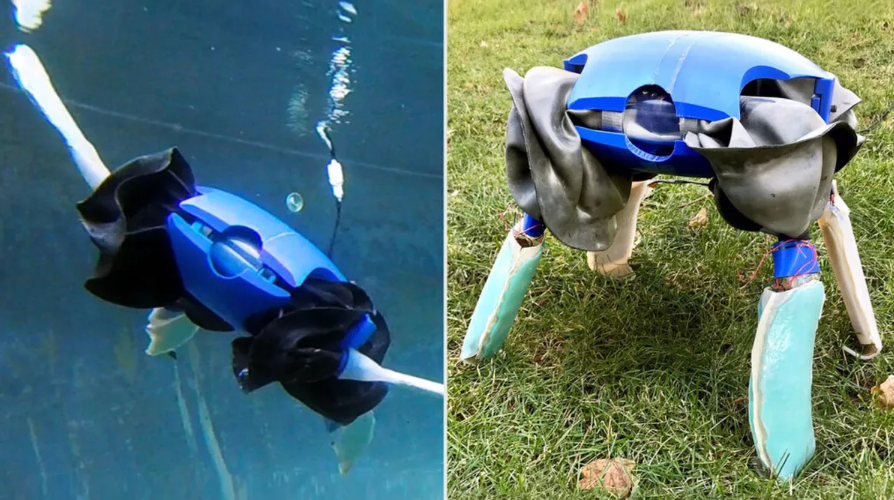 Source: Yale University
As such, the new robot can alter the shape, stiffness and behavior of its limbs according to its environment thanks to its composition of artificial muscles and materials of varying stiffness.
According to its developers, the robot leverages shape adaptation to employ the same parts for both propulsion in water and land environments, turning its four legs into flippers when introduced to water and back again when on land.
Possible applications for Art include ocean farming, diving support and coastal ecosystem monitoring.
The article, Multi-environment robotic transitions through adaptive morphogenesis, appears in the journal Nature.