Study: Flaring allows more methane into the atmosphere than previously thought
Marie Donlon | October 16, 2022Researchers from the University of Michigan have determined that the practice of venting — the burning off of methane, a greenhouse gas, at oil and gas wells to keep it from escaping into the atmosphere — is not as effective as previously thought.
Using data taken from aerial surveys conducted over three geographical basins that are home to 80% of U.S. flaring operations, the researchers determined that flaring’s effectiveness is overestimated, and that flaring releases five times more methane than previously thought.
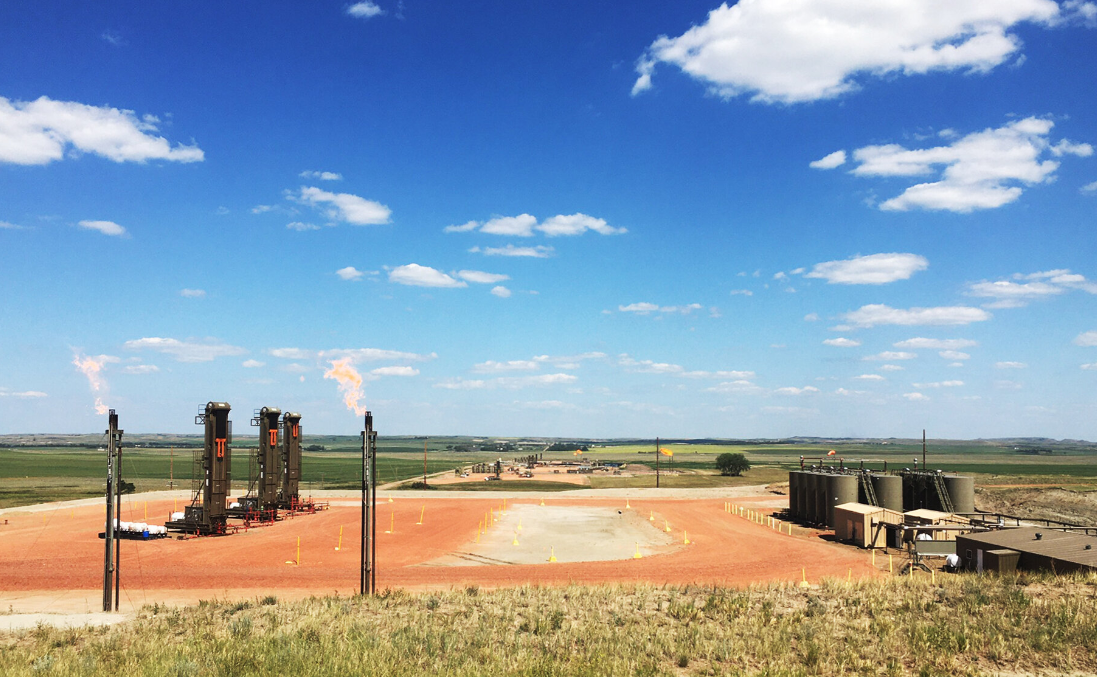 Multiple flares observed in operation in the Bakken Formation in the Williston Basin in North Dakota, 2021. Source: Alan Gorchov Negron, University of Michigan and Yulia Chen of Stanford University
Over three years, the researchers flew planes outfitted with air monitoring equipment to measure the amount of methane released from flares across oil and gas production basins in the Permian and Eagle Ford oil and gas fields in Texas and the Bakken oil and gas field in North Dakota.
As planes flew downwind of flaring sites, a series of tubes and pumps drew air into the onboard instrumentation, and laser scanning was used to measure the amount of methane and carbon dioxide — which is the byproduct of flaring methane — the samples carried.
"If the flare is operating as it should be, there should be a large carbon dioxide spike and a relatively small methane spike. And depending on the relative enhancement of those two gasses, we can tell how well the flares are performing," said Genevieve Plant, lead author on the study and an assistant research scientist in climate and space sciences and engineering.
Previously operating under the assumption that flares are lit at all times and burning off 98% of methane when in operation, the researchers discovered that flares were unlit roughly 3% to 5% of the time. Further, even when lit, the flares were determined to be operating at low efficiency. Such factors, according to the researchers, revealed an average effective flaring efficiency rate of just 91%.
An article detailing the findings, Inefficient and unlit natural gas flares both emit large quantities of methane, appears in the journal Science.
For more information, watch the accompanying video that appears courtesy of the University of Michigan.