
Big waste problem for small nuclear reactors
S. Himmelstein | June 03, 2022Small modular reactors (SMRs) offer a lower initial capital investment, greater scalability and siting flexibility for locations unable to accommodate more traditional larger reactors. Rather than powering the backbone of large transmission systems to distant markets, microreactors are designed to serve local users that are remote or need isolation, are energy constrained or are confined to markets traditionally served by fossil fuel sources. However, despite smaller size and some inherent safety advantages relative to conventional reactor systems, SMRs will greatly increase the load of radioactive waste requiring management and isolation.
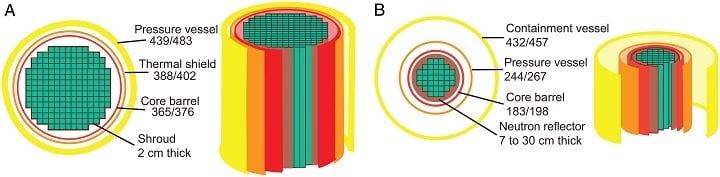 To-scale depiction of (A) 1,000 MW PWR and (B) 50 MW NuScale PWR cores showing inner and outer diameters of cylindrical components (in centimeters) and color coded according to anticipated status as short-lived (yellow) or long-lived (light red and maroon) low- and intermediate-level waste. Source: Lindsay M. Krall et al.
University of British Columbia, Canada, and Stanford University researchers analyzed three types of SMRs under development by Toshiba, NuScale and Terrestrial Energy. As a result of their smaller size, SMRs will experience more neutron leakage than conventional reactors, which in turn affects the amount and composition of waste streams. In terms of waste produced per unit of electricity generated, the study published in Proceedings of the National Academy of Sciences indicates that a 30 MW capacity SMR could increase the volume of short-lived low and intermediate level waste by up to 35 times compared to a conventional 1,000 MW pressurized water reactor (PWR). SMRs are predicted to produce up to 30 times more long-lived equivalent waste.
[See also: The potential and challenges of microreactor technology]
After 10,000 years, the radiotoxicity of plutonium in spent fuels discharged from the SMR types examined would be at least 50% higher than the plutonium in conventional spent fuel per unit of energy extracted.
And, as has been noted in Ukraine, the design must take into consideration the effects of bombardment during warfare.
In reply to #1
Nobody died from radiation, in fact you can't find an example where this has occurred...You're beating the drum of a false prophet...
It's about time someone recognized the waste problem. Is the cost of guarding the waste for 10000 years included in the cost per kwh? All these nuclear reactors and their waste are time bombs that future generations will have to deal with. Is the planet safe with all these nuclear fission reactors?
In reply to #2
Nuclear energy is the safest form of energy that exists....why don't you read book once in a while?
In reply to #4
Only one big failure and the safety rate goes sky high! With bombs, virgins, and fast tracks, it's going to happen.