Plans to ramp up PV module recycling
S. Himmelstein | March 23, 2022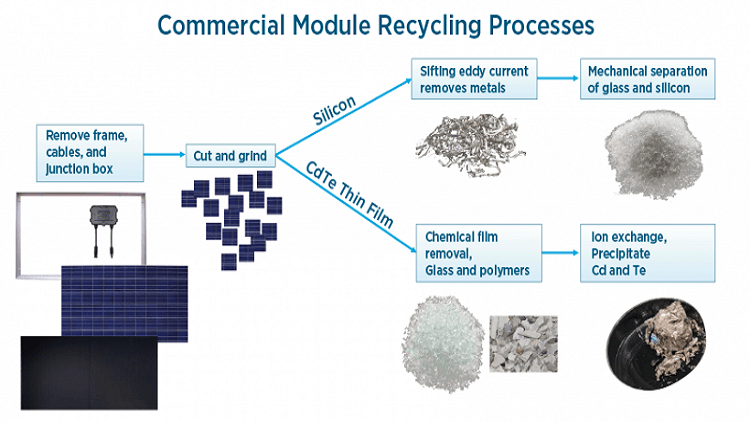 Source: DOE
With the increasing deployment of solar energy systems worldwide, more photovoltaic (PV) components will reach the end of their useful life (EOL) and enter the waste stream. Although 95% of a PV module is recyclable, the current economics of EOL handling are unfavorable, as the cost to recycle these components is significantly higher than landfill fees.
Most PV systems are young: about 70% of currently operating solar energy systems have been deployed in the past five years. The estimated operational lifespan of a PV module is about 30 years, although some may produce power much longer. So, while there are not many systems entering the waste stream right now, more systems will come to their EOL in the next few decades. To address this looming issue, an action plan released by the U.S. Department of Energy (DOE) Solar Energy Technologies Office seeks to establish safe, responsible and economic EOL practices for solar modules.
The five-year strategy focuses on outreach with stakeholders, data gathering and analysis, and hardware and processes research. An improved understanding of the state of EOL can be gained through development of a database that tracks materials, quantity, age, location, cause of EOL and EOL handling for modules. The agency plans to establish a database and data standard for PV EOL with the goal of gathering data on more than 10 MW worth of PV EOL system components, including modules, by 2025.
Research to reduce the amount of materials, especially critical materials, and energy needed to produce system components will reduce the resources needed to process EOL materials as well. These efforts are intended to bring the cost of recycling solar panels to about $3 per panel by 2030, a threshold that would make the practice economical for the first time.