Laser driver tech braces economical fusion power
S. Himmelstein | February 09, 2022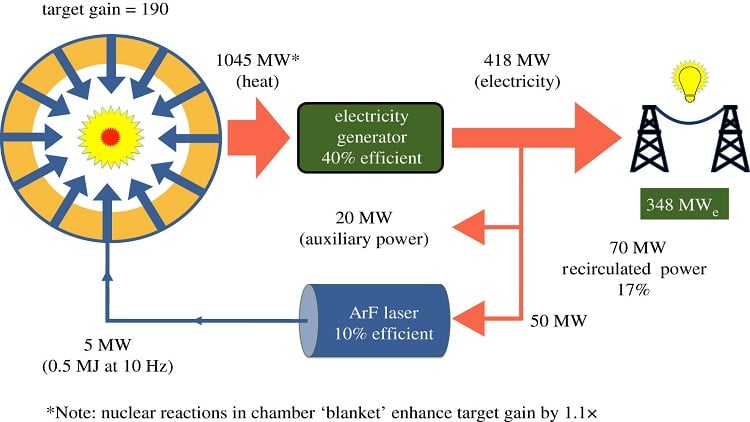 Power flow diagram for a power plant using a 0.5?MJ ArF laser and a high-gain direct-drive shock-ignited target. Most of the generated power (83%) is available for distribution to the grid due to the combination of a high-energy gain implosion and a fairly efficient ArF laser driver. Source: S. P. Obenschain et al
An argon fluoride (ArF) laser intended to advance fusion power as a practical commercial technology is being developed by researchers from the U.S. Naval Research Laboratory and PLEX LLC (Massachusetts). The wide-bandwidth ultraviolet (UV) laser is engineered to have the shortest laser wavelength that can scale up to power a self-sustaining fusion reaction.
ArF is a promising technology for achieving the high-gain inertial fusion implosions needed for energy production. Laser fusion involves the implosion of small capsules to achieve the high densities and temperatures (100 million° C) required to initiate fusion reactions. The ArF laser is intended for a test facility based on the principle of inertial confinement fusion. In these systems, a bead of deuterium or tritium is fired upon by multiple lasers, heating and compressing it in a fraction of a second to such an extent that the hydrogen atoms implode, fuse and release energy.
The new deep UV laser reportedly transfers energy to the fuel bead with greater efficiency and produces much higher temperatures to generate the implosion. Using radiation hydrodynamics simulations indicate that that performance could be increased a hundredfold with an efficiency of 16%, compared to only 12% from the next most efficient krypton fluoride laser.
High-energy ArF lasers will require a significant investment to reach the performance required for fusion and the energy, repetition rate, precision and billion-shot class reliability necessary for a commercial power plant. According to the researchers, demonstration of this potential could facilitate the development of modest size, less expensive fusion power plant modules operating at laser energies less than 1 mega joule (MJ).
The research appears in Philosophical Transactions of the Royal Society.