Nanometer-level precision motion control solutions and applications
Ryan Clancy | February 08, 2022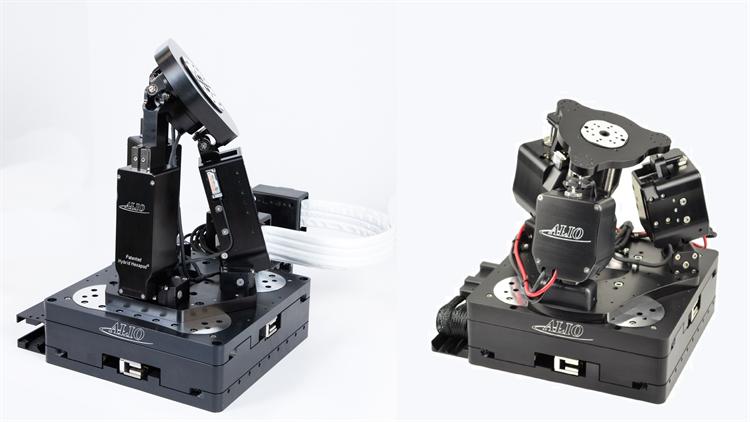 Source: Alio Industries/Twitter
The robotics industry today is driven by the ultimate quest for smaller components and parts, often coming with features at a sub-micron level, more reliable, repeatable, and accurate manufacturing processes. A vital part of the innovation in this area and the shrinking of components is nanometer-level high-quality motion control solutions
If there is a discussion regarding high-level precision motion control, then the vast number of hexapod devices that are on the market today cannot be ignored. However, there is a lot of misinformation around these systems, due to supplier advertising and lack of proper standardized testing. This leads to manufacturers being confused as to which solution may the correct one for them.
Precision is a very vague term; a bit ironic that there isn’t precision for when the word precision is used. This is actually quite unhelpful when discussing motion control solutions. Let’s take it for the purposes of this article that precision represents nanometer precision, which is a measurement only useful in industry if it is repeatable 100% of the time.
Nano and sub-micron precision
Among the existing hexapod options on the market right now, there is one that stands above the rest in terms of speed, precision and travel range. That device is the ALIO Industries’ Hybrid Hexapod. Where traditional hexapods face a lot of restrictions in these categories, this particular device can achieve the sufficient precision and efficiency required by the precision motion control industry. With this next generation of devices represented by the Hybrid Hexapod, nano-level and sub-micron precision and greatly increased accuracy are definitely possible.
How do these new devices achieve this?
The typical hexapod structures solely rely on parallel motion, whereas these new hexapods utilize a combination of serial and parallel kinematic structures to achieve its unique movement. Generic hexapods use six legs to move, whereas a tripod, rotation stage that provides six degrees of freedom (6DOF), and a traditional X-Y stage is used in these new models. Tip/tilt and Z-plane motion is made possible by the kinematic structure (parallel) on the tripod, which is then combined with a kinematic structure (monolithic serial) to give motion on the X and Y axes.
[Discover more about multi-axis positioning systems at GlobalSpec.com]
This new combination negates the previous positioning errors and limitations associated with typical hexapods. With this new generation of devices, the precision and accuracy of serial kinematics and the compactness and flexibility of parallel kinematic devices gives users all of the advantages that a 6DOF hexapod can offer, without any of the drawbacks. This key difference in these new devices (6DOF positioners) gives them the ability to be used in a vast array of new industries and applications, some not previously viable for hexapods. They are truly innovative devices, that will stimulate even more innovation towards the next iteration of hexapods.
Applications of nanometer-level motion control solutions
The innovations of the Hybrid Hexapod has led to a potential new standard in the motion control industry and opens up a whole new world of possibilities for this technology.
Aerospace industry
The aerospace industry utilizes hexapods in their metrology systems. Optical elements demand ultimate precision, and this device can measure, characterize, and test optical components and subassemblies. It is specifically used in the precision assembly process between Optical Image Stabilization (OIS) and CCD arrays which are very high-res. Here the hexapod is the device that creates motion and can manipulate the OIS in 6DOF to make sure bonding and alignment is accurate to a nanometer level.
4K lenses
Typical 4K lenses demand extremely high-tech material technologies, precision assembly practices, and very sophisticated manufacturing processes and techniques. Tolerances are pretty much zero in all directions. The manufacturing processes used to create the lenses can often lead to inaccuracies, which is why they need constant active alignment. The sensor and lens are lined up while multiple targets are projected along the lens, to the sensor and then the image is taken. Modulation transfer function (MTF) is always constantly monitored by the active alignment device to keep each MTF value within pre-determined limits. When the limits are satisfied, an adhesive is partly cured using ultraviolet light, and then a total thermal cure will be completed later. This ensure extreme accuracy when aligning the lens and sensor planes. Hexapods containing their new functionality are perfect for this application, as their absolute repeatability and precision will produce accurate results again and again.
This new ability to control motion down to a nanometer level repetitively brings the motion control industry to a whole new level. It gives new product a chance to emerge based on this new technology and allows products like the Hybrid Hexapod to expand into new industries and stay at the cutting-edge of technology.