Video: Team to track objects via invisible labels
Marie Donlon | February 18, 2022A team of researchers from Massachusetts Institute of Technology’s (MIT’s) Department of Electrical Engineering and Computer Science and MIT’s Computer Science and Artificial Intelligence Lab (CSAIL) has developed embeddable tags for tracking objects.
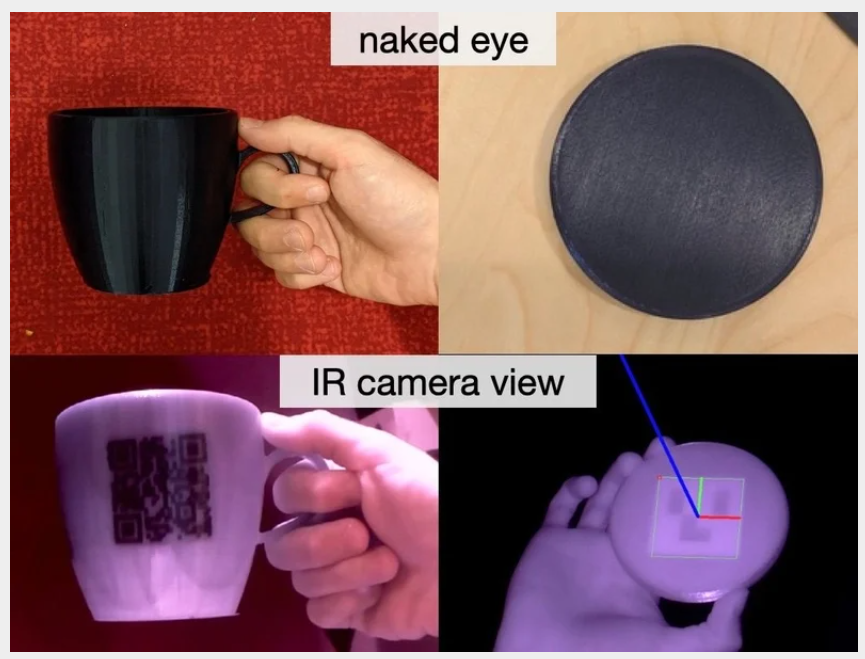
The so-called InfraredTags are an alternative to standard barcodes typically adhered to products that can be easily removed, detached or become unreadable over time. Conversely, the InfraredTags are incorporated into objects during the 3D-printing process and are imperceptible to the naked eye, according to its developers.
 Source: MIT CSAIL
To conceal the tags within the object, the researchers employed two kinds of plastic: one that transmits infrared (IR) light and an opaque plastic where code is inscribed. Using IR light from a smartphone, for instance, could "see" through the opaque material to reveal the object’s associated code.
According to the InfraredTags’ developers, the tags can feature barcodes, QR codes and ArUco (fiducial) markers, for instance. Additionally, the team built a software “user interface” that establishes what the tag should look like and where it should be placed within an object.
These tags could potentially reveal details about the object such as where it was manufactured, what materials were used in its manufacturing and instructions for repairing the object in the event it sustains damage, among other details.
So far, the researchers have developed several prototype products featuring the incorporated InfraredTags, including mugs with barcodes inscribed beneath a 1 mm plastic shell that can be read by IR camera.
If further developed, the MIT team envisions that the technology could be used in in conjunction with smartphones to turn lights on and off, control speaker volume or change the temperature on a thermostat. The team is also exploring the potential for adding IR cameras to augmented reality (AR) headsets that could be worn in grocery stores that consumers use to access information, via concealed barcode, about products they are considering purchasing.
The paper, “InfraredTags: Embedding Invisible AR Markers and Barcodes into Objects Using Low-Cost Infrared-Based 3D Printing and Imaging Tools,” is set to be presented this spring at the ACM CHI Conference on Human Factors in Computing Systems, held in New Orleans.
Watch the accompanying video that appears courtesy of MIT for more information about the InfraredTags.