Smart Battery Could Boosts Electric Vehicles' Range
Engineering360 News Desk | December 07, 2015German researchers have developed an energy storage device for electric cars that allows for the replacement of individual defective cells rather than the entire battery.
In existing designs, a car battery is only as strong as its weakest cell. If a cell is “empty,” the energy in the other battery cells is not available and the car has to be recharged. For that reason, manufacturers presort and install cells of a similar capacity into a battery. Because some cells are sorted out as a result of this process, this pushes up the price of the batteries.
Researchers at the Fraunhofer Institute for Manufacturing Engineering and Automation IPA in Stuttgart, Germany, created a modular battery system that they say solves this problem. Each battery cell has a built-in microcontroller that records relevant physical parameters such as the temperature and the state of charge of the cell. As a result, each cell “knows” what condition it is in.
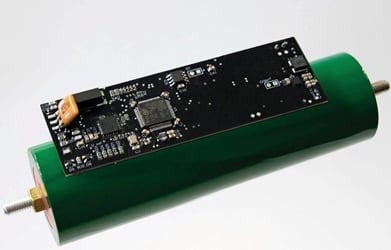 Intelligent cell switches itself off when it is empty. Image credit: Fraunhofer IPA.The cells “talk” to each other via the existing power wiring between battery cells in a process known as power-line communication. They also can communicate with other devices, such as a car's on-board computer, which may use data from the cells to calculate how much remaining energy the battery still has, the so-called “state of charge.”
If a cell is empty but others have energy stored, the empty battery cell decouples from the cluster, acting like a current by-pass. The others continue to deliver energy.
“Depending on the cell quality, we can therefore increase the range by at least 4%,” says Dr. Kai Pfeiffer, group manager at the IPA. “Over time, this effect is amplified: in the case of an old battery, and if the empty cells are replaced, it is conceivable that a range up to 10% higher can be achieved."
Because one cell with lower capacity hardly affects the overall range of a car, manufacturers no longer need to presort them, which could reduce battery costs.
The researchers have already developed a prototype of the battery cell. One challenge now is to miniaturize the electronics and embed them into cells.