Sensor Technology Could Lighten EV Batteries
John Simpson | January 04, 2017Engineers at Ruhr University, in Germany, have developed a concept for current and voltage sensors that they say could help make electric vehicle (EV) batteries lighter and less expensive.
An EV battery is comprised of individual blocks, each of which contains up to 12—usually lithium—cells that are monitored by sensors for flammability. A battery typically has one current sensor and multiple voltage sensors—in the case of the latter, the same number as there are individual cells. A new system designed by researcher Philip Dost requires only one voltage sensor per battery regardless of the number of cells, thus reducing weight and cost.
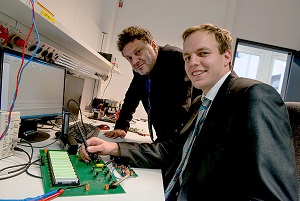 Ruhr University researcher Philip Dost (r) and Constantinos Sourkounis , professor in the Faculty of Electrical Engineering and Information Technology, have developed technology that requires only one voltage sensor per EV battery. Image credit: ©RUB, Marquard.Moreover, in the new system, both current and voltage sensors assume an additional function that must otherwise be installed in batteries as a separate component—cell balancing—which ensures an even energy redistribution among the cells.
Each cell reacts differently during charging and discharging and, by the end of the process, some are more charged than others. Once one cell is full, charging of the other cells is discontinued. If one of the cells is empty, no energy is extractable from the other cells either. Cell balancing is critical to counteracting this phenomenon, ensuring that older systems continue providing maximum energy yield.
According to the researchers, their system is scalable, which means it can be deployed in batteries with different numbers of cells. Additionally, it is suitable not only for batteries in electric vehicles, but for other energy storage systems as well—for example, in mobile devices such as tablets, laptops and wireless electrical tools.
Next, the researchers intend to evaluate their prototype in detail with the objective of meeting the requirements of the automotive industry, Dost says.