Discovery Could Enable Portable Particle Accelerators
Engineering360 News Desk | December 01, 2015University of Maryland (UMD) physicists have accelerated electron beams to nearly the speed of light using low-energy lasers, a development that could lead to the construction of inexpensive, portable particle accelerators.
The scientists accelerated high-charge electron beams to more than 10 million electron volts in one-thousandth of a second using millijoules of laser pulse energy, roughly the same amount of power consumed by a typical household lightbulb.
“Because the laser energy requirement is so low, our result opens the way for laser-driven particle accelerators that can be moved around on a cart,” says Howard Milchberg, UMD professor of physics and electrical and computer engineering and senior author of a paper published in Physical Review Letters.
The UMD team began with a technique known as laser-driven plasma wakefield acceleration and pushed it to the extreme. Generally, the approach works by shooting a laser pulse into plasma, which is a gas (in this case, hydrogen) that has been fully ionized to remove all the electrons from the gas atoms.
An intense laser pulse creates a plasma wake that follows the laser, much like the wake that trails a speedboat. A group of electrons following the initial laser pulse can “surf” the waves of this wake, accelerating to nearly the speed of light within millionths of a meter.
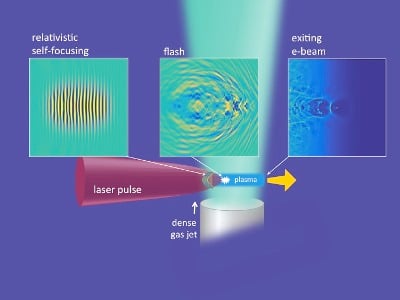 Schematic of the laser-driven electron accelerator experiment. Image credit: Howard Milchberg/George Hine.“Unless your laser pulse can induce the plasma wake in the first place—and it takes a very intense pulse to do that—you’re out of luck,” Milchberg says. Prior efforts needed much bigger laser energies to accomplish this effect. So Milchberg and his team tried to force the plasma itself to transform a weak laser pulse into a very intense one.
When a laser pulse passes through plasma, the laser causes the electrons to wiggle in the laser field. The electrons in the center experience the most intense part of the beam, so they wiggle the fastest. As they do, they become more massive. The result is that the center of the beam—where the electrons become heaviest—slows down compared to the outer parts of the beam. This causes the beam to self-focus, gaining intensity as it collapses, finally generating a strong plasma wake.
The team took advantage of this self-focusing effect, increasing the density of the plasma to as much as 20 times that used in typical experiments. In the process, they also reduced the laser pulse energy needed to initiate relativistic self-focusing and thereby generate a strong plasma wake.
“If you increase the plasma density enough, even a pipsqueak of a laser pulse can generate strong relativistic effects,” Milchberg says.
“We started with a very powerful laser and found that we were able to keep dialing the energy back. Eventually we got down to about 1% of the laser’s peak energy, but we were still seeing an effect,” says Andrew Goers, a graduate student.
The laser-driven accelerator produces a beam of electrons and radiation, including gamma rays, that can be used for safe medical imaging and other applications without the need for significant levels of radiation shielding outside the beam path.
In terms of sheer acceleration, laser-driven particle accelerators have a long way to go before they are ready for applications in high-energy physics. But for more immediate applications, such as ultra-fast medical and scientific imaging, the main barriers to laser-driven acceleration are cost, complexity and portability.