
Food freezing technique promises improved quality, reduced energy use
Marie Donlon | September 10, 2021Scientists from the U.S. Department of Agriculture's Agricultural Research Service (ARS) and the University of California (UC)-Berkeley suggest that a new food freezing technique could save energy, reduce carbon emissions and improve the quality of frozen foods.
The technique, called isochoric freezing, stores food in sealed, rigid containers — typically composed of plastic or metal — and entirely filled with water or another liquid. Once filled, the food is immersed in the liquid and placed in a freezer.
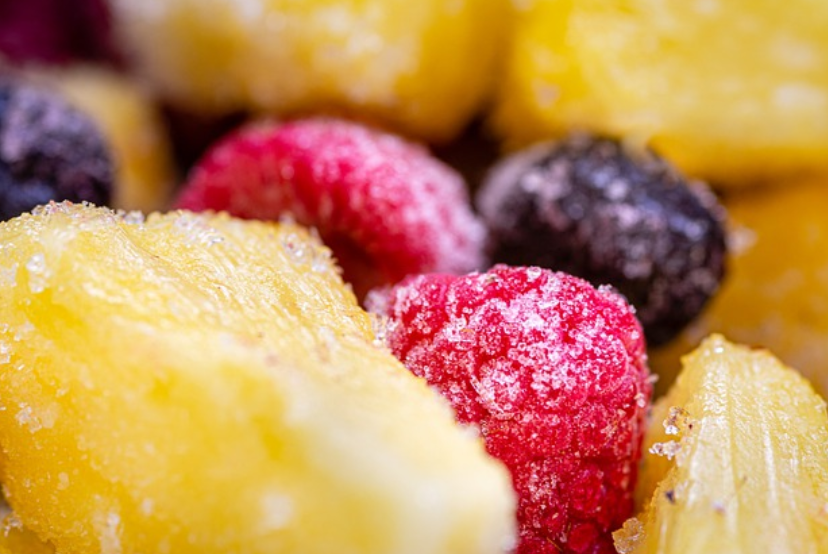
While conventional food freezing exposes food to the air, freezing it solid at temperatures under 32° F, the isochoric freezing method preserves the food without turning it into solid ice. This is due to food being entirely submerged in the liquid ahead of freezing, thereby preventing ice crystallization — which is a common threat to food quality.
In addition to improving the quality of frozen foods, the team of scientists suggest that an energy savings is a likely result of isochoric freezing because freezing foods completely solid demands a significant amount of energy as do cold storage protocols like quick freezing, which is commonly used to help avoid ice crystal formation.
"A complete change over to this new method of food freezing worldwide could cut energy use by as much as 6.5 billion kilowatt-hours each year while reducing the carbon emissions that go along with generating that power by 4.6 billion kg, the equivalent of removing roughly one million cars from roads," said ARS research food technologist Cristina Bilbao-Sainz.
The team of scientists believe that the process could enable the freezing of commonly difficult to preserve foods like tomatoes, cherries and potatoes. Additionally, the researchers report that microbial contaminants are destroyed with isochoric freezing.
Originally developed to cryopreserve tissues and organs for transplants by a UC-Berkeley biomedical engineer, isochoric freezing could potentially be used for other applications such as medicine, biology and space travel.
The study, Analysis of global energy savings in the frozen food industry made possible by transitioning from conventional isobaric freezing to isochoric freezing, appears in the journal Renewable and Sustainable Energy Reviews.


This is interesting. The container prevents the water from expanding so it cannot crystallize. Consequently, it continues to cool through and below the freezing point instead of giving up the latent heat of fusion (which must be removed in the normal freezing process). Apparently the water is not actually frozen, but is supercooled, in a state similar to the thin film of liquid water that forms under pressure where the blade of an ice skate contacts the surface. Or does it form an amorphous glass-like solid? What is the pressure in the container at sub-freezing temperatures?
What I do not understand is the claim that the process will destroy pathogens, but does minimal damage to the cells of stored food. Are bacteria more vulnerable to pressure changes?
We've been preserving fish this way for many years. Today, a thin film of water is spayed on the fish and then quickly frozen. It seems that it would have the characteristics as the submerged fish. But it doesn't. I'm going to freeze a tomato completely submerged in water and save it for a week. Then, I'm going to thaw it out and see if I can slice it for a hamburger.
This is too early of a report, more like a preprint. To achieve sub-0°C conditions with total immersion in water, the authors require use of a container that has no change in volume. Then they suggest that existing commercial food freezing lines can be modified to allow this work to be done at only modest cost. These two statements do not fit together. After the product has been preserved "isochorically" what is the method for continuing to maintain the total lack of volume change from the processing plant through the distribution network to the ultimate consumer?
I think the theory has some room to be plausible, but the suggested results are not. Look at this as nonsense.
--JMM
In reply to #3
I'll let you knw how good it works when I thaw out my tomato. Hey hey.