UN Reaches Agreement on Airliner-Tracking System
Engineering 360 News Desk | November 16, 2015Global tracking of airliners came one step closer to reality after agreement was struck at the United Nations (UN) to allocate radio frequency spectrum for airplanes to report their locations to satellites.
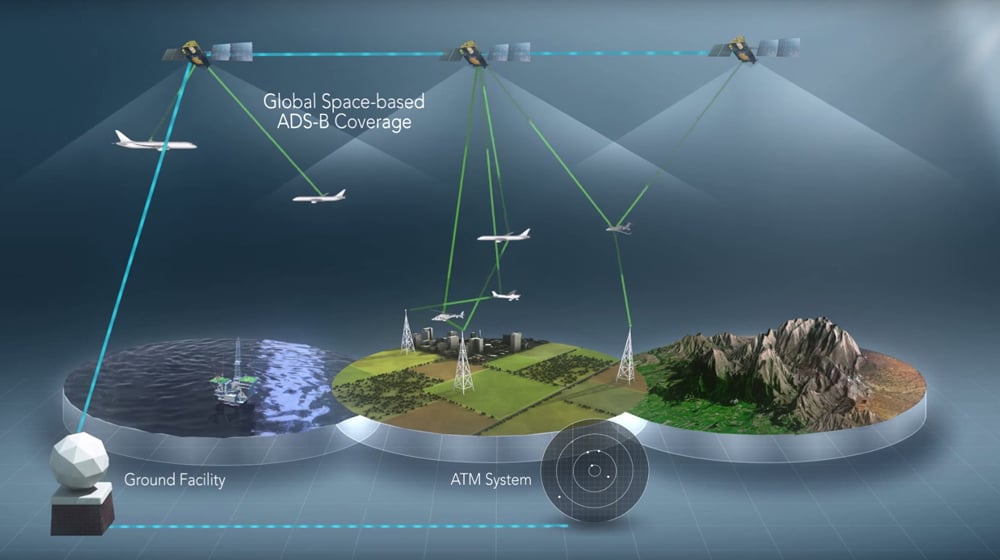 Global flight tracking by satellites. Source: ITUThe UN's International Telecommunications Union announced on November 11 that the frequency band 1087.7-1092.3 MHz would be allocated for this purpose. The frequency is currently being used for the transmission of aircraft signals to ground-based stations within "line-of-sight."
The move is in response to the loss of Malaysia Airlines Flight MH370 in March 2014. The flight vanished on a route from Kuala Lumpur to Beijing in its flight path and presumed crash location remain unaccounted for.
Insert image here: Extending airplane tracking from earth-based stations to space-based satellites will effectively allow reporting of airliners' locations over the roughly 70% of the earth's surface that is covered by water, including oceanic, polar and other remote areas.
“The allocation of frequencies for reception of ADS-B signals from aircraft by space stations will enable real-time tracking of aircraft anywhere in the world,” says François Rancy, director of the ITU Radiocommunication Bureau.
Earlier in 2015, a separate UN agency, the International Civil Aviation Organization, recommended that airliners be required to transmit their location every 15 minutes.
The flight-tracking system is expected to be implemented in 2017.