
A powerful future projected for US battery storage
S. Himmelstein | August 17, 2021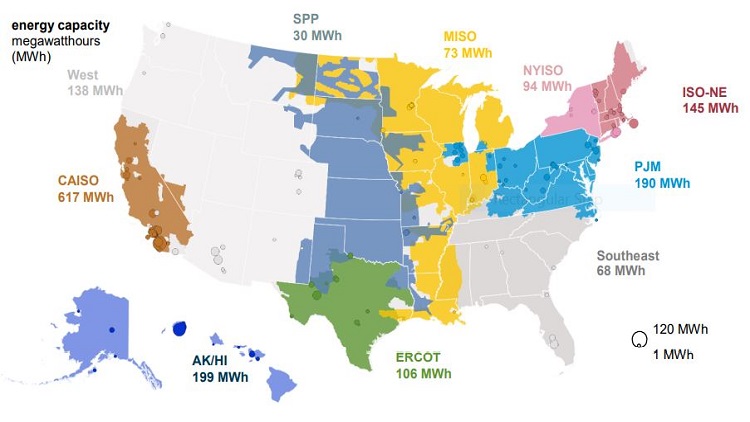 Energy capacity data for large-scale battery storage installed in 2019. Source: EIA
The U.S. has experienced significant growth in large-scale battery capacity, which reached 1,650 MW by the end of 2020. According to data collected and analyzed by the U.S. Energy Information Administration (EIA), national battery power capacity grew by 35% in 2020 and has tripled in the last five years.
At the end of 2019, 163 large-scale battery storage systems were operating in the U.S., a 28% increase from 2018. The energy capacity of these sites was 1,688 MWh, and the maximum power that could be provided to the grid from these sites at any given moment was 1,022 MW. Declining technology costs have bolstered much of the recent growth, with battery storage costs falling by 72% between 2015 and 2019, a 27% per year rate of decline.
EIA projects that most large-scale battery energy storage systems expected to come online in the U.S. over the next three years will be co-located with photovoltaic power plants. If all currently announced projects from 2021 to 2023 become operational, then the share of U.S. battery storage that is co-located with generation would increase from 30% to 60%.
An additional 10,000 MW of large-scale battery storage’s ability to contribute electricity to the grid is likely to be installed between 2021 and 2023 in the U.S. — 10 times the total amount of maximum generation capacity by all systems in 2019.



I have said it before and it makes more sense these days. The simplest method to reduce energy costs and land coverage is to install solar panels on each home. Not sufficient to over produce but sufficient to run a standard home independent of a supplier. Back this up with a small roof top wind turbine and the problem is solved for most utility suppliers.
Rather than dumping used solar panels give them to home owners for use to supplement their power needs. They have no value in a land fill site. They are written off by the company and have no tax deductable value. A few years of usage helps this idea of CO2 saving. I am sure the home owners would enjoy some cost savings in electricity.
The down side, the utilities will complain to loss of some revenue, (poor utilities), but they could claim this ridiculous CO2 tax saving and still remain profitable with the big consumers like business's who are the main culprits of CO2 production and high electricity uses that everyone worries about.
The cost to recycle panels is higher than the give-away cost, so why not install the used panels on houses. The panels still have life for home use.
If you want to save the world, one cannot have cake and eat it all. And certainly the aliens are not to interested our problem.
The alternate, wait until a hydro-thermal vent erupts from frac'ing or oil drilling, and then watch the CO2 level shoot up.