NIST tests biopharmaceutical quality control method
Amy J. Born | June 29, 2021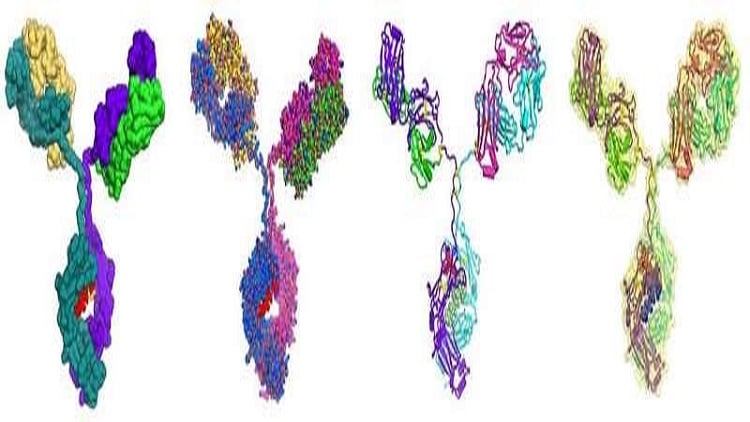 The NIST monoclonal antibody (NISTmAb). Source: NIST
The past year has drawn attention to the necessity of getting life-saving medicines to patients quickly and safely.
A new multi-attribute method (MAM) for monitoring the quality of biopharmaceutical products is an emerging, mass spectrometry-based technique that monitors product quality and detects multiple types of potential impurities with a single-step test. The method has been evaluated in an inter-laboratory study conducted by the U.S. National Institute of Standards and Technology (NIST) in partnership with 28 laboratories representing the biopharmaceutical industry, instrument and software vendors, and the federal government.
Participants used the NIST Monoclonal Antibody (NISTmAb) Reference Material 8671 as a model test sample to evaluate MAM. They were asked to report any differences discovered between the altered NISTmAb test samples received and the unaltered reference material.
According to the study results, the participating labs successfully used MAM to identify several different alterations in the samples. Differences included impurities and chemical transformations that require tight controls in the production of biopharmaceutical products.
The study also outlines best practices for improving reliability, as well as current capabilities and challenges associated with MAM.
"The ultimate goal is to speed the time-to-market for life-saving medicines through more efficient quality control methods," said NIST research chemist Trina Mouchahoir. "And this study provides a roadmap for getting there."
The results of the study were recently published in the Journal of the American Society for Mass Spectrometry.