A revised fault diagnosis method for nuclear power plants
S. Himmelstein | June 18, 2021Fault diagnosis technology contributes to the safety and reliability of nuclear energy production but the time- and labor-intensive nature of network structure model development results in low process efficiency. Researchers in China devised a method to optimize the network structure of fault diagnosis and enhance fault diagnosis accuracy.
A data-driven fault diagnosis model for complex systems of nuclear power plants was defined based on the 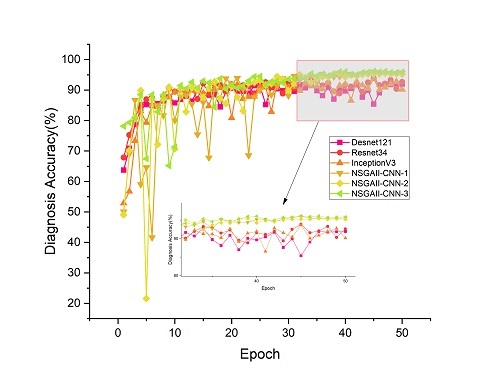 Comparisons of average diagnostic error and complexity. Source: Ge Daochuan et al.analysis of plant operating data. The new adaptive fault diagnosis method combines a non-dominated genetic algorithm with elite retention strategy and convolutional neural network algorithm. The resulting scheme was observed to preserve the time characteristics of data and improve fault diagnosis accuracy.
The proposed method offers significant advantages in fault diagnosis and model structure construction when compared with classical convolutional neural network-based models and is expected to provide operators with useful information to improve self-diagnostic capabilities of nuclear power systems.
The research conducted by scientists from the Chinese Academy of Sciences and the University of Science and Technology of China is published in the Annals of Nuclear Energy.