
New carbon capture method eliminates hazardous impurities
Siobhan Treacy | June 04, 2021Kyushu University and the National Institute of Advanced Industrial Science and Technology, Japan, investigated a new way to store carbon underground. The team studied the geological storage of low purity carbon dioxide mixed with nitrogen and oxygen produced by direct air capture using membrane-based technology.
The current carbon capture process is carried out at localized sources with concentrated CO2 emissions. This method requires intensive purification for storage because the gas contains hazardous compounds, nitrogen oxide and sulfur oxide. The traditional method has high transportation costs because geological storage sites are typically far away from the CO2 sources.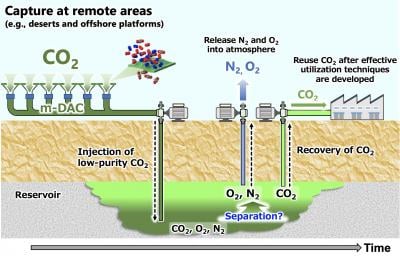 Schematic image of low-purity CO2 storage with the membrane-based Direct Air Capture (DAC). Source: Takeshi Tsuji
Direct air capture of CO2 can be performed anywhere. It doesn’t need an intensive purification process because its impurities are not hazardous. Low purity CO2 can be captured and injected directly into geological formations.
While the new process is promising, the team says there is still more research to be done before it can be implemented. A better understanding is needed of how the resulting mixture behaves when injected and stored in geological formations. However, preliminary research suggests that geological storage of mixtures produced via direct air capture is environmentally safe and economically viable.
A study on the new method was published in Greenhouse Gases: Science and Technology.

Here is a novel carbon capture device that uses renewable solar energy to operate and then yields useful by-products as well as sites to install children's play equipment and avian housing sites and provides all-natural silent air conditioning for those in its immediate vicinity.
"A better understanding is needed of how the resulting mixture behaves when injected and stored in geological formations."
What a load of bollocks this is, Smoke and mirrors. Plant trees and stop the carnage in rain forests. That is a better idea ad less damaging to the earth and geological formations.
The more people think they have mastered tech, the more silly and lazy they become.
Dig a hole and plant a tree.