Watch how a biodegradable mini-capacitor is 3D printed
S. Himmelstein | June 03, 2021The ever-increasing demand for batteries to power consumer devices and wearables adds to the rising tide of electronic waste. Technology to help stem this deluge of discarded energy supply and storage devices is being advanced at the Swiss Federal Laboratories for Materials Science and Technology (EMPA) in the form of a 3D-printed and biodegradable mini-capacitor.
The disposable device is produced with a modified, commercially available 3D printer fed gelatinous inks composed of cellulose nanofibers, cellulose nanocrystals, carbon black, graphite and activated carbon. Four 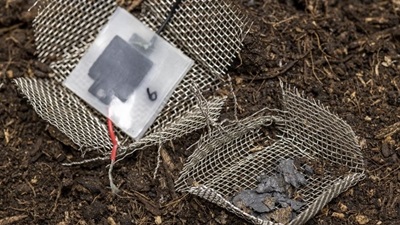 This capacitor disintegrated after two months buried in soil, leaving only a few visible carbon particles. Source: Gian Vaitl/EMPAlayers of these ingredients, liquefied with glycerin, water and alcohol, are deposited by the printer, starting with a flexible substrate, a conductive film, the electrode and finally the electrolyte. The structure is then folded to place the electrolyte in the center.
The resulting mini-capacitor maintains stable high performance operation over thousands of charge and discharge cycles. The device was documented to achieve a high capacitance of 25.6 F/g active material at an operating voltage up to 1.2 V. The disposable, nontoxic power supply is also resistant to pressure and shock, and more importantly, it will biodegrade naturally at the end of its long service life.
A paper on this research is published in Advanced Materials.