
The value of vertical axis wind turbines
S. Himmelstein | May 02, 2021The efficiency and power output of wind energy systems can be increased by shifting from the horizontal to the vertical. Traditional horizontal axis wind turbines (HAWTs) produce turbulence that undermines the performance of other turbines downwind while vertical axis wind turbines (VAWTs) enhance the performance of turbines clustered together.
Researchers from Oxford Brookes University and University of Oxford, U.K., analyzed data from over 11,000 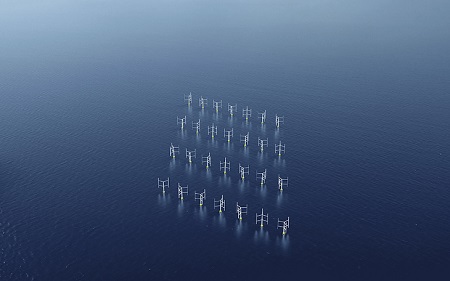 Optimization of VAWT spacing increases the efficiency and power output of wind farms. Source: Oxford Brookes Universityhours of 2D computational fluid dynamic simulations of paired VAWT operation. When placed in pairs, the VAWTs are observed to increase each other’s power output by up to 15%.
An assessment of 25 different turbine arrangements determined that the optimal layout is based on a VAWT spacing of three turbine diameters and an array angle of 60° with co-rotating rotors. Increasing the number of turbines further increased overall efficiency, as did increasing the turbine spacing.
The research published in Renewable Energy is claimed to be the first to comprehensively evaluate multiple aspects of wind turbine performance, including array angle, direction of rotation, turbine spacing and number of rotors.




Wind generation system type Economics 101:The question of purchase & maintenance costs between the two rotations quickly rises. Simple equation is:
$WLv - $PMLv > $WLh - $PMLh
$WLv: lifetime profit per watt vertical
$WLh: lifetime profit per watt horizontal
$OMLv: lifetime cost purchase & operations vertical
$OMLh: lifetime cost purchase & operations horizontal
There may well be, and probably is, a duration factor between the lifetimes of the two systems. Purchase Costs include both manufacturing & installation costs.
If 3-diameter spacing is optimal, why does increasing the spacing improve efficiency?